How AI Search Is Changing the Future of SEO
The rapid rise of AI search engines is completely transforming how we find information on the internet. For over two decades, the web operated on a simple premise: a user types a fragmented query into a traditional search box, the engine retrieves a ranked list of hyperlinks, and the user clicks through multiple websites to piece together the answer. This era of information retrieval was dominated by Google, shaping the entire digital marketing industry and giving birth to Search Engine Optimization (SEO). However, today, that fundamental user behavior is undergoing a seismic and irreversible shift. AI search engines Driven by Large Language Models (LLMs) and platforms like ChatGPT, Google’s AI Overviews, Microsoft Copilot, and Perplexity, search is rapidly evolving from a simple information retrieval system into a complex intent resolution engine.

The Evolution of Search: From Directories to Artificial Intelligence
To understand the future of search, we must briefly contextualize its past. The early internet relied on web directories like Yahoo, where human editors manually categorized websites. This was highly inefficient and quickly replaced by Google’s algorithmic approach in the late 1990s. Google's PageRank algorithm revolutionized the web by treating backlinks as votes of confidence, establishing the first true era of technical and off-page SEO.
For the next twenty years, SEO became a game of reverse-engineering algorithms. Marketers focused on keyword density, meta tags, link-building velocity, and site architecture. While Google continuously updated its algorithms (Panda, Penguin, Hummingbird, BERT) to understand natural language better and penalize spam, the core output remained the same: a list of links.s to an index of web pages, AI search engines utilize a technology called Retrieval-Augmented Generation (RAG). When a user asks a question, the AI engine searches the live web for the most relevant, up-to-date information, ingests the content of those pages, and synthesizes a direct, conversational answer in real-time, often citing the sources as footnotes. The search engine is no longer just a librarian pointing you to a book; it has become a researcher reading the book and giving you the exact summary you requested.
What is AI Search and How Does it Differ from Traditional SEO?
The difference between traditional search and AI search lies fundamentally in how they process user intent and deliver value. Traditional SEO relies on the assumption that the search engine is a middleman. The goal of the SEO professional is to convince the middleman to rank their webpage highest so the user will click on it. The value exchange happens on the destination website.
AI search engines attempt to provide the value exchange directly on the search interface. This introduces several paradigm-shifting differences:
The Acceleration of Zero-Click Searches
The most immediate and terrifying impact of AI on traditional SEO is the massive acceleration of "zero-click searches." A zero-click search occurs when a user’s query is answered directly on the Search Engine Results Page (SERP), requiring no further clicks to external websites. While Google introduced Featured Snippets years ago to answer basic questions (like "What is the capital of Bangladesh?"), AI search engines can now answer highly complex, multi-layered questions (like "What is the best digital marketing strategy for a clothing brand in Dhaka with a $500 monthly budget?").
According to a report by Gartner, traditional search engine volume is projected to drop by 25% by 2026, largely due to users turning to AI chatbots and virtual agents for answers. If a generative AI model perfectly answers a user's question—such as a cooking recipe, a quick factual lookup, a coding snippet, or a summary of historical events—the user has absolutely no incentive to click through to a website.
For websites that rely on top-of-funnel, informational queries monetized by display ads, this represents a severe threat. The traditional SEO metric of driving raw, high-volume traffic is becoming less relevant. Instead, the focus must shift toward capturing high-intent traffic that requires deep, nuanced exploration, transactional execution, or human connection that an AI cannot simulate.

Conversational vs. Transactional Intent
AI search models excel at informational and conversational intents. Users speak to AI differently than they type into traditional search bars. Instead of querying "best SEO agency Dhaka," a user might prompt an AI with, "I run a local e-commerce store in Dhaka and need an SEO agency that specializes in technical audits and Meta Ads. Who are the top three, and what are their typical retainer fees?"
However, AI currently struggles with immediate transactional intents. If a user wants to buy a specific pair of sneakers or book a direct flight, they still rely on traditional web interfaces and standard search algorithms. Therefore, traditional SEO will not die; it will become hyper-focused on commercial and transactional queries, while informational queries will be swallowed by generative AI.
The Rise of Generative Engine Optimization (GEO)
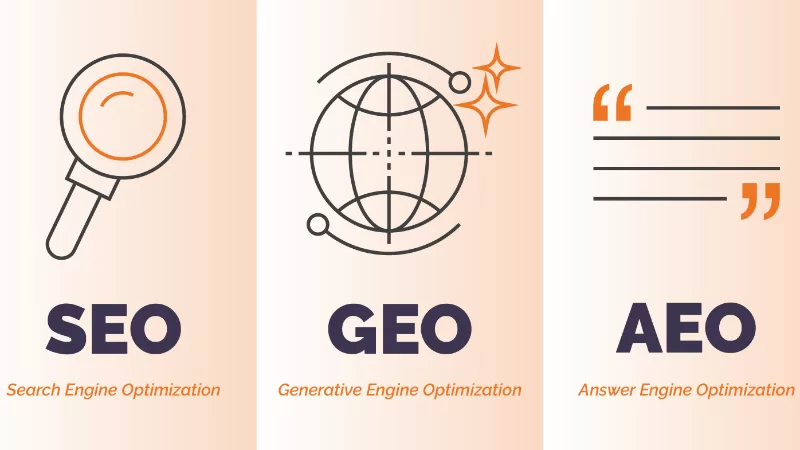
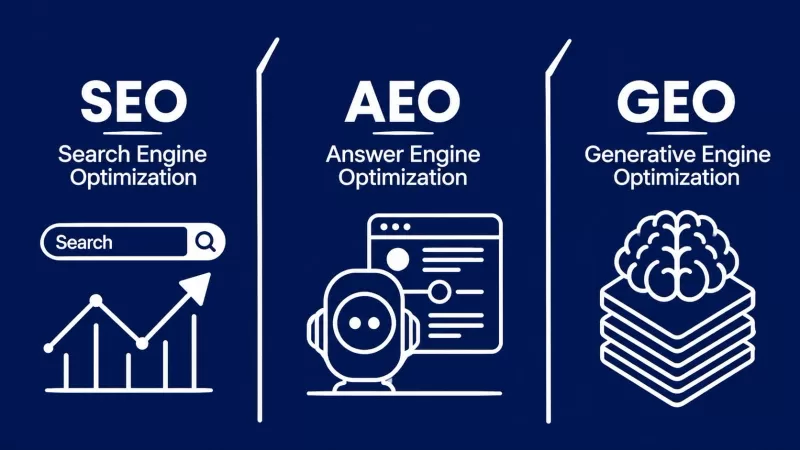
To survive in a post-Google-dominant landscape where AI overviews push organic links far down the page, SEO professionals must pivot from optimizing purely for ranking algorithms to optimizing for Large Language Models. This emerging discipline is widely being termed as Generative Engine Optimization (GEO).
Generative Engine Optimization is the systematic practice of structuring, writing, and formatting content so that AI models not only understand it but actively choose to cite it as a primary source in their generated responses. AI engines look for highly structured, authoritative, fact-dense, and easily parsable content.
The Mechanics of GEO: How to Get Cited by AI
Recent academic studies by researchers from Princeton and Georgia Tech on Generative Engine Optimization have revealed that standard SEO practices do not always translate to AI citations. To improve visibility in AI-generated answers, marketers must adopt specific GEO tactics:
- Fact-Dense Content: LLMs are trained to look for empirical data. Including specific statistics, measurable outcomes, and concrete numbers heavily increases the chance of being cited. Instead of saying "SEO improves traffic," state "Organic traffic increased by 45% over six months by resolving 404 errors."
- Authoritative Quotations: Embedding quotes from recognized industry experts gives AI models a verified source to extract and present to the user.
- Clear Semantic Formatting: AI models parse content much like a machine reader. Using strict, logical Markdown structures—such as clear H2s and H3s, bulleted lists, bolded key terms, and comprehensive data tables—helps the RAG system easily extract the information.
- Addressing Conversational Long-Tail Queries: Content must be structured in a Q&A format that mirrors how users talk to voice assistants and chatbots.
Key Pillars of SEO Strategy in the AI Era
The integration of AI into search demands a complete overhaul of how we approach content creation and digital marketing. Marketers can no longer rely on producing generic, 500-word blog posts optimized for a single keyword. The new strategy rests on three major pillars.
Doubling Down on E-E-A-T and The Human Element
With AI capable of generating endless amounts of grammatically perfect but fundamentally generic content in seconds, human-generated content must offer something AI cannot: unique, lived experiences. Google’s E-E-A-T framework—Experience, Expertise, Authoritativeness, and Trustworthiness—is now the ultimate defense against AI obsolescence.
To prove "Experience," writers must use first-person narratives, original photographs, and case studies. An AI can summarize how to perform a technical website audit, but it cannot share the specific frustrations of fixing a custom Shopify server-side tracking issue for a client in Dubai. Personal anecdotes, unique viewpoints, and demonstrated hands-on experience signal to both search engines and human readers that the content is authentic.
Information Gain: The Antidote to AI Parrots
"Information Gain" is a patented concept by Google that measures how much new, unique information an article brings to a specific topic compared to the articles already ranking for that topic. If your article merely rewrites what is already out there, an AI search engine will ignore it because it already possesses that baseline data.
To achieve high Information Gain, marketers must conduct original research, run surveys, publish proprietary data, or present a highly contrarian but well-argued opinion. In the AI era, you are no longer competing against other websites; you are competing against the sum total of human knowledge already ingested by the LLM. You must add something genuinely new to the dataset.
From Keyword Stuffing to Entity-Based SEO
AI search engines do not read words as strings of text; they understand concepts, known as "entities," and the relationships between them. An entity can be a person (Tompa Akter Oishey), a place (Dhaka), a brand (Bizwyse), or a concept (Digital Marketing).
In the future of SEO, building a robust Knowledge Graph around your brand entity will be far more important than stuffing a landing page with variations of a long-tail keyword. How do you optimize for entities?
- Digital PR: Getting mentioned by other authoritative entities (news sites, industry blogs).
- Co-occurrence: Ensuring your brand name frequently appears alongside your target concepts (e.g., your agency name always appearing in discussions about "Conversion API" or "Meta Ads").
- Schema Markup: Using advanced structured data (JSON-LD) to explicitly tell search engines who you are, what you do, and how you connect to the broader industry.

The Changing Metrics of Success
For over twenty years, the ultimate KPI of SEO was organic traffic. Marketers measured success by how many clicks they drove to a website. In an AI-dominated landscape with rising zero-click searches, relying solely on traffic as a success metric is a trap.
Digital marketers must adapt their reporting frameworks. The new metrics of success will include:
- Brand Mentions in AI Outputs (Share of Model): Tracking how often your brand or website is cited when users ask AI tools about your industry.
- Branded Search Volume: If an AI overview recommends your brand as the best solution, the user might subsequently Google your brand name directly to make a purchase.
- Conversion Rate over Traffic Volume: You may receive 50% less traffic because AI answers the low-intent questions, but the traffic that does click through to your site will be highly qualified and ready to convert. The focus shifts entirely to the bottom of the funnel.
Conclusion: Embracing the AI-Powered Search Landscape
Artificial Intelligence is not here to destroy the digital marketing industry; it is here to refine and elevate it. The days of gaming algorithms with thin content and manipulative link-building are permanently over. As the digital landscape moves "beyond Google" as we traditionally know it, the future of SEO belongs to those who prioritize deep subject matter expertise, entity authority, and Generative Engine Optimization.
By focusing on creating original, highly structured, data-rich content that addresses complex user intents, digital marketers can ensure their brands remain visible, relevant, and authoritative. The interface may change from a list of blue links to a conversational chatbot, but the core human need for reliable, trustworthy information remains. The future of SEO is not about ranking for a keyword; it is about becoming the definitive, undeniable source of truth that the AI itself relies upon.
Frequently Asked Questions (FAQs)
Q1: Is traditional SEO completely dead because of AI search engines?
No, traditional SEO is not dead, but it is fundamentally evolving. While AI will take over top-of-funnel informational queries (like "what is a meta tag"), traditional SEO will remain highly relevant for transactional queries (like "hire an SEO agency in Dhaka") and local searches. Furthermore, technical SEO (site speed, mobile responsiveness, schema markup) will become even more critical, as AI models need well-structured sites to crawl and extract data efficiently.
Q2: How can I track the success of my SEO efforts if AI engines reduce traditional click-through rates?
As zero-click searches rise, digital marketers must shift their Key Performance Indicators (KPIs) away from raw organic traffic. Success should be measured by "Share of Model" (how often your brand is cited by AI tools like ChatGPT or Perplexity), increases in direct branded search volume (users searching for your brand name specifically after an AI recommended you), and the conversion rate of the traffic that does land on your site.
Q3: What is the primary difference between SEO and GEO (Generative Engine Optimization)?
Traditional SEO focuses on optimizing content to satisfy a search engine's ranking algorithm to appear at the top of a list of links (optimizing for the click). GEO focuses on structuring content so that an AI Large Language Model understands, trusts, and extracts your information to synthesize a direct answer (optimizing for the citation). GEO heavily prioritizes fact density, authoritative quotes, structured data tables, and high Information Gain.
Written by
Tompa Akter Oishey
Comments (0)
No comments yet — be the first to share your thoughts.