AI Search SEO: How Generative Search Changes Visibility

Alt Text: Workflow diagram showing how conversational user queries pass through AI synthesis to generate trusted brand citations.
Quick Answer: AI search SEO means crafting clear, verifiable content so generative engines and AI Overviews cite your business directly inside their answers. Although instant summaries lower casual link clicks, publishing structured explanations, real local proof, and crawlable pages helps brands capture motivated visitors.
Introduction
Search any topic online today and, right at the top of the screen, a synthesized paragraph frequently delivers the exact answer before you even see a single website link. That user experience defines modern AI search SEO. For local entrepreneurs and aspiring marketers across Bangladesh, this triggers a critical dilemma: when potential buyers get instant solutions on the results page, does website optimization still pay off?
The reality is encouraging—provided you adapt how you publish. Generative search has not eliminated SEO; rather, it has expanded our goal from chasing ten-blue-link rankings to becoming the primary source both human readers and AI models rely upon. In this guide, we break down how search engines are evolving, what recent click studies show, how AEO and GEO operate, and five actionable tactics you can implement immediately.
How Is Search Changing?
Legacy search engines acted like a giant library index. You typed two or three keywords, scanned a list of ten links, and opened multiple browser tabs to compare information yourself. Today's AI search behaves like a dedicated research analyst. Features like Google's AI Overviews and AI Mode, along with conversational assistants such as ChatGPT and Perplexity, read across dozens of web pages simultaneously and compose a single coherent reply.
Google's technical documentation explains that AI Overviews and AI Mode often use a method called "query fan-out." Essentially, the engine splits your original prompt into several smaller background searches covering related subtopics and data sources before assembling its final response. For content writers, this creates a major opportunity: your page can be cited for a specific follow-up angle even if you never targeted that exact phrase in your title.

Traditional search
AI search
Output
A ranked list of website links
A unified written answer with inline source citations
User effort
Open multiple tabs and cross-check facts
Read one synthesized summary and ask follow-up questions
Query style
Short, fragmented keyword phrases
Detailed, conversational, multi-layered questions
Success metric
Top-three organic link placement
Direct brand mention or cited reference link
Your content's job
Earn the initial click from search results
Provide clear, trustworthy facts worth quoting
One important detail often goes unnoticed: Google states that AI Overviews only appear when its systems judge that a generative summary offers clear value beyond classic web results. Because of this threshold, standard organic links still drive the majority of everyday searches.
What Is the Real Impact on SEO?
Clicks. Findings from a March 2025 Pew Research Center study tracking 900 U.S. adults illustrate how AI boxes alter user clicking habits. Visitors clicked a standard web link in 8% of searches displaying an AI summary, versus 15% on pages without one, while citations embedded inside the summary box drew clicks in just 1% of visits (Pew Research Center, 2025). Keep the context clear: this sample measures U.S. browsing over a single month rather than Bangladeshi users. At the same time, Google Search Central notes that visitors who click through from AI Overviews demonstrate deeper engagement and longer time on site. Both trends happen simultaneously: fewer casual clicks, yet higher-intent leads.
Intent. Users now write highly specific queries—for example, asking which weekend digital marketing training in Dhaka suits a university graduate looking for freelance work. Detailed pages built around real user scenarios consistently beat generic overview posts.
Brand authority. When a generative summary highlights only two or three brands, off-site credibility carries massive weight. Verified business profiles, authentic customer reviews, and third-party web mentions now directly power your AI search SEO visibility.
Measurement. Google explains that traffic generated by AI search features is combined inside total Search Console metrics. Since AI referrals cannot yet be filtered separately, marketers should monitor overall lead conversions and branded search demand rather than isolated click numbers.

What Are AEO and GEO, and How Do They Differ from SEO?
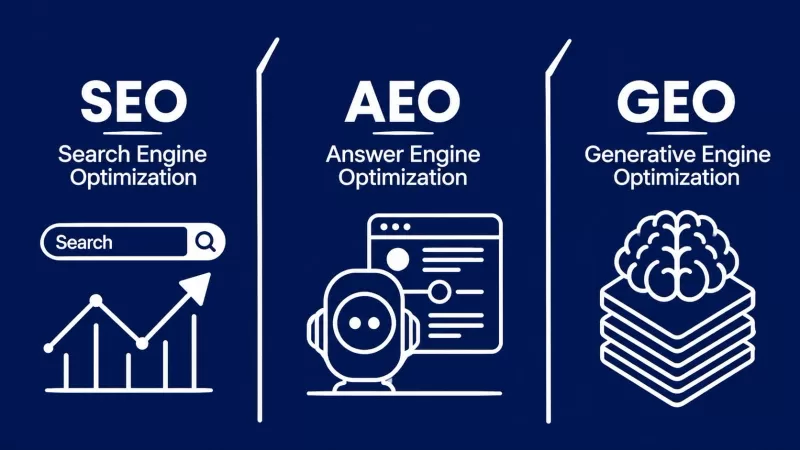
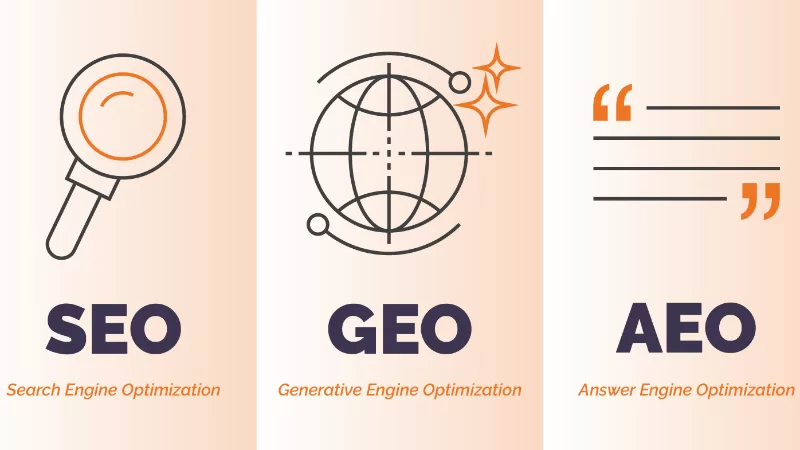
Answer Engine Optimization (AEO) involves structuring web pages so search engines and voice assistants can lift crisp, direct answers immediately—usually via question-styled headings followed by concise definitions or bulleted steps. Generative Engine Optimization (GEO) focuses on positioning your brand and original insights so AI platforms like ChatGPT, Gemini, or Perplexity cite you inside conversational replies.
Traditional SEO remains the core foundation covering technical crawlability, topical relevance, and backlink trust. The main difference comes down to the target outcome: SEO aims for page rankings, AEO aims for direct answer snippets, and GEO aims for brand citations inside synthesized AI text.
Are these completely separate strategies? In its May 2026 resource on generative AI features, Google emphasized that optimizing for AI experiences on Google Search is still rooted in core SEO fundamentals and existing quality systems. However, external AI tools weigh ranking signals differently, so testing across multiple platforms is vital.

My Mini Test: Google vs. an AI Tool
Star section. Replace every yellow bracket with your own real observation. Do not paste AI-generated results, and verify anything the AI tool told you.
I ran the exact same question across two platforms on [date]: [your exact question, e.g., Dhaka-y best digital marketing course ki?]
What I checked
AI tool: [name]
Format of the answer
[describe: AI Overview? organic links? local map?]
[describe: summary paragraph? bullet list? table?]
Sources shown
[which websites or directories appeared]
[which sites were cited, or none]
Did I need to click to get my answer?
[yes/no, and explain why]
[yes/no, and explain why]
Was the Bangladesh information correct?
[what local details I verified]
[what local details I verified]
Was my own or a local site mentioned?
[yes/no]
[yes/no]
Key takeaway from this test
[1-2 sentences on what this means for my SEO]
[1-2 sentences on what this means for my GEO]
What surprised me: [2 to 3 sentences in your own words describing what differed between Google and the AI assistant]
What this means for SEO: [1 to 2 sentences explaining what type of pages got cited and how you will structure your own articles]
[Image 3: Insert your own side-by-side Mini Test screenshot here, with caption: My Mini Test, (date): comparing Google and (AI tool name).]
How Do You Adapt Your AI Search SEO? 5 Practical Steps
Picture a small organic honey and mustard oil store in Rajshahi shipping nationwide across Bangladesh. This is an illustrative example rather than a real case study.
1. Answer immediately, then add depth. Place a direct 40-to-60-word explanation right under question-style headings, such as "How can you verify pure Sundarbans honey in Bangladesh?" This layout satisfies both human scanners and AI extraction models.
2. Publish firsthand proof AI cannot copy. Original sourcing photos, lab test certificates, transparent BDT pricing, and real buyer reviews distinguish your site from generic summaries. Google's May 2026 guide highlights unique, experience-driven content as the strongest long-term advantage.
3. Keep technical indexing fundamentals clean. Google confirms that pages simply need to be crawlable, indexed, and eligible for standard search snippets—no special AI text files or proprietary tags are required. Check robots.txt permissions, strengthen internal links, and optimize mobile speed.
4. Strengthen off-page brand reputation. Maintain matching business details across your Google Business Profile, Facebook page, and local directories while encouraging verified customer reviews. AI engines cross-reference external platforms before recommending a brand.
5. Cover natural bilingual search habits. Searchers in Bangladesh frequently blend English, Bangla, and Banglish terms. Include natural phrasing variations inside your subheadings and FAQs without awkward keyword stuffing.
Check your Google Search Console trends every month, and re-test your Mini Test query regularly to see how citations evolve.
What Are the Limits and Risks?
Inaccurate hallucinations. AI systems sometimes state outdated or incorrect details with high confidence, especially on local Bangladeshi prices or schedules. Always verify every AI-generated number against an authoritative primary source before publishing.
Copyright and attribution friction. Generative summaries pull insights from original creators while sending fewer referral clicks, fueling ongoing debates over publisher credit. Never copy-paste raw AI paragraphs into your work, as it harms originality and risks plagiarism issues.
Click drops on basic queries. Broad, definition-style articles may experience lower organic traffic. Build resilient audience channels through email lists, WhatsApp groups, and social video.
Evolving short-term metrics. Current AI search studies rely heavily on early U.S. data while search interfaces change rapidly. Treat published statistics as directional trends rather than fixed rules.
FAQ
Is traditional SEO dead because of AI search?
No. Google has confirmed that AI Overviews and AI Mode are built directly on its core Search ranking and quality systems. Solid SEO fundamentals still determine whether your content is found and cited.
Do I need a special file or markup for Google AI search?
No special files or proprietary markup are required for Google's AI features. Ensuring your page is indexed, crawlable, and eligible for standard snippets is enough.
What should a beginner do first for AI search SEO?
Choose one real question your customers ask, write a clear 50-word answer at the top of the page, include original local proof, and confirm indexing in Search Console.
Conclusion
AI search SEO does not replace proven optimization principles—it raises the bar for genuine usefulness. Content that pairs direct answers, authentic local experience, clean technical health, and trusted brand signals will earn visibility both in organic search results and inside AI-generated citations. Run the Mini Test on one customer question from your industry this week: what critical local detail does the AI answer miss that only your firsthand knowledge can provide?
Image Plan and Alt Tex
1
Featured workflow diagram showing user prompt, AI synthesis, and brand citation. Place directly below the H1.
ai-search-seo-workflow.png
Workflow diagram showing how conversational user queries pass through AI synthesis to generate trusted brand citations.
2
Horizontal bar chart comparing organic CTR with and without AI summaries. Place after the comparison table.
ai-overviews-ctr-impact.png
Horizontal bar chart showing organic click-through rates with and without AI summaries based on Pew Research Center 2025 data.
3
Your own Mini Test screenshot comparing Google and an AI tool side by side. Place inside the Mini Test section.
mini-test-google-vs-ai.png
Side-by-side screenshots comparing Google search results and an AI tool answering a local query in Bangladesh.
References
All accessed 14 November 2026. Open every link and confirm it supports your claim before submitting.
Chapekis, A. (2025, July 22). Google users are less likely to click on links when an AI summary appears in the results. Pew Research Center. https://www.pewresearch.org/short-reads/2025/07/22/google-users-are-less-likely-to-click-on-links-when-an-ai-summary-appears-in-the-results/
Google Search Central. (2026, May 15). Optimizing your website for generative AI features on Google Search. https://developers.google.com/search/docs/fundamentals/ai-optimization-guide
Google Search Central Blog. (2026, May 15). A new resource for optimizing for generative AI in Google Search. https://developers.google.com/search/blog/2026/05/a-new-resource-for-optimizing
Google Search Central. (n.d.). AI features and your website. https://developers.google.com/search/docs/appearance/ai-features
Google Search Central Blog. (2025, May). Top ways to ensure your content performs well in Google's AI experiences on Search. https://developers.google.com/search/blog/2025/05/succeeding-in-ai-search
AI / Third-Party Disclosure
Keep the version that is true for you and delete the other. List any other tools you used.
Version A (AI helped draft): I used an AI assistant to help organize this outline, refine wording, and locate official reference pages. I opened and verified every statistic against the original Pew Research Center and Google Search Central documentation. All Mini Test queries, screenshots, observations, and conclusions are my own. I checked the final text for plagiarism and grammar using [tool name].
Version B (AI for research only): I used an AI tool strictly to find and review official sources. I drafted the entire article independently and verified every fact against primary documentation. The Mini Test and screenshots are completely my own.
Submission Self-Checklist
Check
Status
Step 0 (reader, thesis, my own element) written
Done
Primary keyword in title, meta title, intro, one H2, and conclusion
Done
H1, H2, H3 in correct order
Done
Every fact has a source and year
Re-verify each link
Mini Test has my own observation
To do
Image suggestions and alt text added
Done, add screenshot
AI / third-party disclosure written
Choose a version
Plagiarism and grammar check completed
To do
Uploaded to the official channel before 16 November, receipt confirmed
To do
Written by
Jannatul Ferdous Elma
Comments (0)
No comments yet — be the first to share your thoughts.