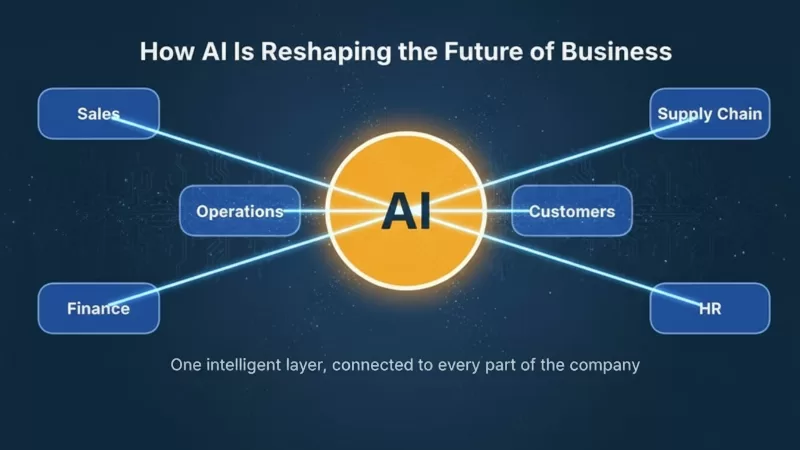
Artificial Intelligence (AI) is no longer a futuristic concept. It has become a practical business tool that is changing how companies operate, communicate with customers, analyze information, and develop new products. From automating everyday tasks to supporting complex business decisions, AI is creating opportunities for organizations of all sizes.
As digital transformation accelerates, businesses are increasingly adopting artificial intelligence to remain competitive. According to McKinsey's 2026 global AI survey, 89% of respondents reported that their organizations regularly used AI in at least one business function. More importantly, the share of AI-using organizations that had reached at least the scaling phase increased from 38% in 2025 to 44% in 2026. These findings suggest that businesses are moving beyond experimentation and increasingly integrating AI into their operations.

Research reference:

Improving Business Efficiency Through Automation
One of the most significant benefits of artificial intelligence in business is improved operational efficiency. AI-powered systems can automate repetitive tasks such as data entry, invoice processing, appointment scheduling, inventory tracking, and customer support.
By reducing manual workloads, businesses can save time, minimize human errors, and allocate resources more effectively. Employees can then focus on activities that require creativity, communication, critical thinking, and strategic planning.
For example, manufacturing companies use AI-powered robots to improve production accuracy, while retailers apply intelligent inventory systems to monitor stock levels and predict demand.
Research published in the Journal of Business Research by Loureiro, Guerreiro, and Tussyadiah (2021) examined 404 academic articles on artificial intelligence in business. Their findings identified organizational impact, AI systems, and societal implications as major research areas, demonstrating the growing importance of AI in business transformation.
Research reference: Loureiro et al. (2021) – Artificial Intelligence in Business: State of the Art and Future Research Agenda.

Transforming Customer Experience and Personalization
Customer expectations are changing. People increasingly expect businesses to provide personalized recommendations, fast responses, and convenient services. AI helps companies meet these expectations through chatbots, virtual assistants, recommendation systems, and customer behavior analysis.
For example, e-commerce platforms use AI to recommend products based on browsing history and previous purchases. Customer service chatbots can answer common questions around the clock, reducing waiting times and improving accessibility.
AI can also analyze customer feedback, identify purchasing patterns, and help businesses understand changing preferences.
These capabilities allow companies to create more relevant customer experiences, strengthen relationships, and improve customer satisfaction. However, personalization should always respect customer privacy and data protection requirements.

Making Smarter, Data-Driven Business Decisions
Data plays an important role in modern business strategy. However, collecting information is not enough. Companies must understand that information and turn it into useful decisions.
Artificial intelligence helps businesses analyze large datasets, identify patterns, forecast trends, and detect potential risks. Machine learning algorithms can process information much faster than traditional manual methods in many applications.
For example, financial institutions use AI to identify suspicious transactions, retailers forecast product demand, and logistics companies optimize delivery routes.
The Organisation for Economic Co-operation and Development (OECD), together with Boston Consulting Group and INSEAD, published a 2025 report examining AI adoption in businesses. The research highlights the importance of improving access to data, strengthening digital skills, and supporting companies as they implement AI.
AI-powered analytics can strengthen decision-making, but human expertise remains essential when interpreting results and evaluating important business decisions.
Research reference: OECD, BCG & INSEAD (2025) – The Adoption of Artificial Intelligence in Firms.

Driving Innovation Across Different Industries
AI is not simply improving existing business processes; it is also creating opportunities for new products, services, and business models.
In healthcare, AI can support medical research, assist with diagnostic processes, and improve healthcare delivery. In manufacturing, predictive maintenance systems can identify potential equipment problems before major failures occur.
In finance, AI supports fraud detection, risk analysis, and customer service. Meanwhile, marketing teams use generative AI to develop content ideas, analyze campaign performance, and create personalized marketing strategies.
The World Health Organization (WHO), in its 2021 publication Ethics and Governance of Artificial Intelligence for Health, recognizes AI's potential to improve diagnosis, treatment, health research, and drug development. The guidance also emphasizes the importance of safety, transparency, accountability, and human rights.
Research reference: World Health Organization (2021) – Ethics and Governance of Artificial Intelligence for Health.

Changing the Workforce and Future Business Skills
The growing use of AI is changing the way employees work and the skills businesses need. Although automation can reduce demand for certain repetitive tasks, it also creates opportunities in technology, data analysis, cybersecurity, and AI management.
The World Economic Forum's Future of Jobs Report 2025 estimates that 39% of workers' existing core skills will change by 2030. The report highlights the growing importance of AI, big data, technological literacy, creative thinking, and continuous learning.

For businesses, this means employee training and professional development must become important parts of digital transformation.
Rather than viewing AI only as a replacement for human workers, organizations should focus on human-AI collaboration. AI can handle data-intensive tasks, while employees contribute judgment, creativity, emotional intelligence, and leadership.
Research reference: World Economic Forum (2025) – Future of Jobs Report 2025.

Addressing AI Challenges, Privacy, and Ethical Responsibilities
Despite its advantages, artificial intelligence also introduces significant challenges. Data privacy, cybersecurity, algorithmic bias, inaccurate outputs, and a lack of transparency can create risks for businesses and their customers.
For instance, an AI system trained on biased information may produce unfair recommendations or decisions. Similarly, sharing confidential business information with poorly governed AI tools can expose sensitive data.
The WHO's guidance on AI governance emphasizes six important principles, including human autonomy, safety, transparency, accountability, inclusiveness, and sustainability.
Although the guidance focuses specifically on healthcare, these principles offer valuable lessons for organizations using AI in other sectors.
Businesses should establish clear AI policies, protect sensitive information, regularly evaluate automated systems, and maintain human oversight. Responsible implementation is essential for building customer trust and achieving sustainable results.
Research reference: WHO (2021) – AI Ethics and Governance Guidelines.

What Does the Future of AI in Business Look Like?
The future of business will increasingly involve collaboration between people and intelligent technologies. Advances in machine learning, generative AI, natural language processing, and AI agents are expected to create new opportunities for automation, customer engagement, and business innovation.
McKinsey's 2025 research found that 62% of surveyed organizations were experimenting with AI agents, while many companies were still working to scale their AI initiatives. This suggests that businesses are moving beyond simple AI applications toward more advanced systems capable of supporting multi-step workflows.

However, successful AI adoption requires more than purchasing advanced software. Companies need clear objectives, reliable data, skilled employees, appropriate infrastructure, and effective governance.
Small businesses can also benefit by starting with practical applications such as customer support automation, content assistance, and sales analysis.
Research reference: McKinsey & Company (2025) – The State of AI in 2025.
Conclusion: AI Is Shaping the Next Generation of Business
Artificial intelligence is transforming business operations, customer experiences, decision-making, and innovation. Its growing influence is creating new opportunities for companies while introducing challenges related to privacy, security, workforce development, and responsible technology use.
Businesses that approach AI strategically can improve efficiency, respond more effectively to customer needs, and discover new opportunities for growth.

Ultimately, the future of business will not depend on technology alone. It will depend on how effectively organizations combine artificial intelligence with human creativity, experience, and judgment.

Comments (0)
No comments yet — be the first to share your thoughts.