Introduction
Artificial intelligence for business growth has moved from a bold idea to an everyday tool in only a few years. Not long ago, advanced software was a luxury for global giants with huge research budgets. Today a small online store, a local clinic or a family factory can use similar technology through a phone, a browser or a monthly subscription. The change is fast, and it is touching every part of working life. Whether you manage a startup, teach a class or simply want to understand where work is heading, this shift is worth your attention.
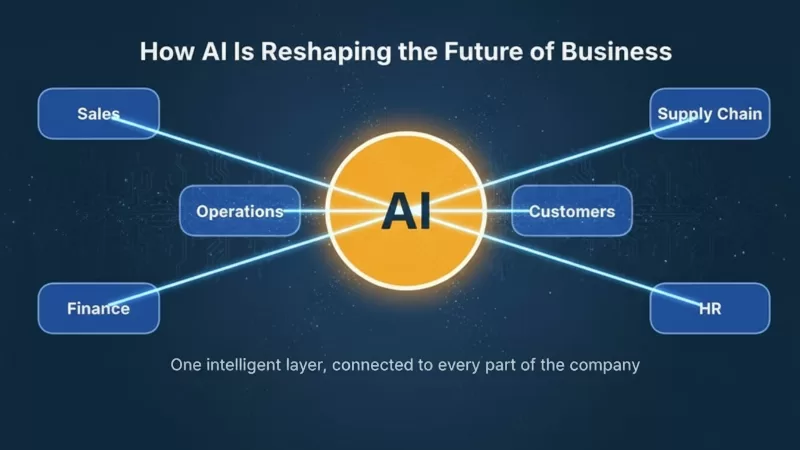
In this guide, you will learn how artificial intelligence for business growth actually works, which departments gain the most, what independent research reveals, and which risks deserve respect. You will also find a clear six-step plan that any team can follow, whether it has five employees or five thousand. The aim is simple: to explain how AI is reshaping the future of business in plain, practical language.
Understanding AI and Why It Matters Right Now
What AI Means Inside a Company
Artificial intelligence describes computer systems that can perform tasks which normally need human thinking, such as reading text, recognizing patterns, forecasting outcomes and choosing between options. In business, the most common form is machine learning, a method where software studies thousands or millions of past examples and learns what usually happens next. Instead of a programmer writing every rule, the system discovers the rules from data.
This difference is important. Traditional software does exactly what it is told, and it breaks when something unexpected appears. Learning systems adapt. A fraud detection model, for example, notices that a payment looks unusual compared with a customer's normal behavior, even if no one wrote a specific rule for that situation.
Why the Shift Is Happening Now
Three developments came together. First, companies now record huge amounts of information, from online orders and delivery times to support chats and website clicks. Second, cloud computing made powerful processing affordable, so a business can rent capacity by the hour rather than buy expensive machines. Third, the public arrival of generative AI tools in 2022 allowed ordinary employees to use advanced technology by typing a sentence, with no coding knowledge at all.
As a result, AI has stopped being a project for specialists and has become a skill for everyone. Marketing assistants, accountants, shop owners and students now use it daily, often without thinking of it as a separate technology.
What Research Says About AI Adoption and Results
Independent research gives a clearer picture than headlines do. McKinsey's 2025 global survey, based on 1,993 participants across 105 countries, found that 88 percent of organizations used AI regularly in at least one business function, up from 78 percent a year earlier. [1] That is a remarkable rise in a single year.
However, the same survey delivered a sober message. Only about 7 percent of organizations said AI had been fully scaled across the company, and roughly 39 percent reported any measurable effect on enterprise-level profit. [2] In other words, trying AI is easy, but turning it into business value is much harder.

Figure 2: AI adoption is widespread, but fully scaled results are still rare (McKinsey, 2025).
McKinsey also identified a small group of high performers, around 6 percent of respondents, who gained the most. These organizations were far more likely to redesign their workflows around AI instead of adding a Chatbot to an old process. They also treated AI as a driver of growth and innovation, not only as a way to reduce cost. The lesson is practical: strategy and process change matter more than the tool itself.
How AI Is Changing Core Business Functions
Operations and Workflow Automation
Operations is often the first place where the benefits appear. Workflow automation powered by AI can read invoices, categorize support tickets, match payments to orders and update records across systems. Older automation needed neat, structured inputs. Modern tools handle messy material such as scanned forms, voice messages and informal emails, which is how most real work arrives.
The gains go beyond speed. Fewer manual steps mean fewer typing errors, fewer duplicate payments and fewer forgotten follow-ups. Employees are freed from repetitive tasks and can spend more time on problems that need creativity, negotiation or care.
Sales, Marketing and Personalization
Marketing teams use AI to understand who customers are and what they are likely to want next. By studying browsing behavior, purchase history and responses to earlier campaigns, systems can group audiences, recommend products and select the best moment to send a message. This approach is known as personalization, and it makes communication feel relevant instead of random.
Sales teams benefit in a similar way. Lead scoring tools rank prospects by their likelihood to buy, so representatives call the most promising people first. Meeting summaries, follow-up emails and proposal drafts can be prepared in minutes. The human still builds the relationship, but the preparation becomes lighter.
Finance and Predictive Analytics
Finance leaders have always tried to look ahead, and predictive analytics gives them better tools. Models can estimate cash flow, forecast revenue, identify customers who may pay late and highlight spending that looks unusual. A bank can compare one card payment with millions of earlier patterns in a fraction of a second and block fraud before the money leaves the account.
Accountants and analysts also gain time. Instead of copying numbers between spreadsheets, they can review automatically prepared reports and focus on explaining what the numbers mean for the business.
Human Resources and Talent Management
Recruiters use AI to sort applications, schedule interviews and answer routine employee questions about leave or policies. Learning platforms can recommend courses that match a person's role and progress. These benefits come with a responsibility: if historical hiring data contains bias, a model may repeat it. Human review and regular testing for fairness are therefore essential.
Supply Chain and Logistics
Supply chains create vast streams of data from warehouses, vehicles, ports and suppliers. AI can use that data to forecast demand, suggest faster delivery routes and warn managers about likely delays. When a disruption occurs, such as a port closure or sudden demand spike, early warning gives a company precious time to react.
Customer Service and Customer Experience
Customers now expect quick answers on every channel at every hour. Chatbots and voice assistants can handle routine questions about orders, prices and returns, while human agents focus on complex or sensitive cases. When this handover is smooth, the customer experience improves because people receive help faster and do not need to repeat their story.
The opposite is also true. A badly designed bot that traps people in endless loops damages trust. Successful companies always provide an easy path to a real person and use customer feedback to improve the system.
Generative AI and Natural Language Processing
Natural language processing is the branch of AI that helps computers understand and produce human language. It powers translation tools, voice assistants, email filters and the large language models behind modern chat tools. Generative AI builds on this foundation to create new text, images, code and summaries from a short instruction.
For a business, the practical uses are wide. A manager can turn a long meeting recording into action points. A marketer can produce several versions of an advertisement for testing. A support team can translate answers into several languages. A founder can draft a first proposal and then refine it with expert knowledge.
Yet generative tools require careful handling. They can sound confident while being wrong, and they do not know a company's private rules unless that context is supplied. The most reliable approach is to treat the tool as a fast assistant and to keep a skilled person responsible for checking facts, tone and originality before anything reaches customers.
Industry Snapshots: AI Beyond the Technology Sector
Retail and E-commerce
Online stores use recommendation engines, demand forecasting and automated inventory planning. Visual search lets shoppers upload a photo and find similar products, while dynamic tools help decide which items to promote before a festival or sale season.
Banking and Financial Services
Banks and mobile finance providers apply AI to fraud detection, credit assessment, customer verification and personalized financial advice. When models are tested carefully for fairness, they can extend services to people who lack long credit histories.
Healthcare
Hospitals and clinics use AI to read medical images, organize records, predict which patients may need urgent attention and reduce paperwork. These systems support doctors rather than replace them, giving professionals more time for patients.
Manufacturing and Agriculture
Factories use sensors and machine learning to predict equipment failure before it stops production. In agriculture, farmers can use image analysis and weather data to detect crop disease early and plan irrigation more carefully. In both cases, small improvements in timing and accuracy can save significant money.
Data-Driven Decision Making: From Gut Feeling to Evidence
Many business decisions were once based on experience and instinct. Experience still matters, but data-driven decision making adds a second layer of evidence. Dashboards that combine sales, costs, customer feedback and market signals help managers see patterns that would be invisible in separate spreadsheets.
Good leaders remember an important limit, however. AI produces probabilities, not certainties, and any forecast is only as reliable as the data behind it. The healthiest habit is to ask three questions before acting: Where did this data come from? What might be missing? What would change our mind? With these questions, AI becomes a partner in thinking rather than a replacement for it.
AI Agents: The Next Stage of Automation
The newest development is the rise of AI agents, systems that can plan and complete several connected steps with limited supervision. Instead of answering one question, an agent might gather information, compare options, prepare a report and send it for approval. McKinsey found that 62 percent of survey respondents were at least experimenting with agents, although no more than about 10 percent were scaling them in any single function.

Figure 3: AI agents are widely tested but still early in scaling (McKinsey, 2025).
These numbers show a technology at an early stage. Companies that experiment now, with clear limits and human approval for important actions, will learn faster than those who wait. At the same time, giving software more independence increases the need for monitoring, logging and clear accountability.
The Benefits and Challenges at a Glance
When AI is aimed at a well-defined problem, the advantages are easy to describe:
• Faster work: tasks that took hours, such as report preparation or document sorting, can finish in minutes.
• Fewer errors: automated checks catch typing mistakes, duplicate payments and missing information.
• Better forecasts: models highlight likely demand, risk and cash needs before problems appear.
• Lower waste: accurate planning reduces unsold stock, idle time and unnecessary spending.
• New opportunities: patterns in customer data reveal products and services that people truly want.

Figure 4: Benefits and challenges of using AI in business.
Key Challenges and How to Manage Them
Poor Data and Weak Foundations
AI learns from data, so messy records create messy results. Many companies keep information scattered across spreadsheets, old systems and personal files. Before buying any tool, it is wise to audit what data exists, who owns it, how accurate it is and where it is stored. Cleaning data is not glamorous, but it often delivers more value than any advanced model.
Privacy, Security and Accuracy
Customers share personal details only when they trust a company to protect them. Businesses must follow data protection laws, limit access to sensitive information and be open about how data is used. McKinsey's survey found that about half of respondents had already experienced at least one negative consequence from AI, with inaccuracy being the most common. Testing and human review are therefore not optional extras.
Bias and Fairness
Algorithms can copy unfair patterns hidden in historical data. A hiring or lending model trained on biased decisions may continue them at scale. Regular audits, diverse test groups and clear appeal routes help reduce this risk, especially when AI influences opportunities in people's lives.
Skills, Culture and Cost
Technology rarely fails because of code alone. It fails when employees fear it, managers do not understand it or nobody owns the outcome. Training, open communication and visible leadership support are essential. Costs also need attention: subscriptions, integration and staff time should be compared with measured benefits, not with excitement.
Responsible AI: Building Trust Inside and Outside the Company
Responsible use is not only an ethical matter; it is a business advantage. Customers, partners and regulators increasingly expect companies to explain how automated systems affect them. A simple governance framework can help: write clear rules for approved tools, decide which data must never be entered into public systems, require human review for high-impact decisions and record who is accountable for each AI process.
Transparency matters as well. When a customer is speaking to a machine, the company should say so. When AI helps create content, an honest disclosure builds credibility. Trust takes years to earn and moments to lose, so it deserves the same care as any financial asset.
A Six-Step Roadmap to Start with AI
A company does not need a research laboratory to begin using artificial intelligence for business growth. A steady path with six stages works for most teams, and each stage keeps risk small while learning grows.

Figure 5: A six-step roadmap for starting with AI.
1. Set a business goal. Decide what you want to improve, such as response time, sales conversion or reporting accuracy.
2. Audit and clean your data. Gather the information the goal depends on, remove duplicates and secure sensitive records.
3. Pick one use case. Choose a task that is repetitive, measurable and low in risk instead of trying to change everything at once.
4. Pilot for four to eight weeks. Test with a small group, compare results with the old method and record time and cost savings.
5. Train staff and set rules. Explain what the tool can and cannot do, who reviews its output and which data is off limits.
6. Measure and scale. Expand only what proves its value, and review quality, privacy and fairness on a regular schedule.
A Practical Example: A Small Online Clothing Store
Imagine a small online clothing store with five employees. The owner begins with one problem: customers keep asking the same questions about sizes, delivery and returns. A simple chatbot answers those questions, and the team saves several hours every week. Next, the owner connects sales records to a forecasting tool that shows which items are likely to sell before a festival season. Orders to suppliers become more accurate, and fewer products remain unsold.
Finally, generative AI helps write product descriptions and social media captions, while a team member reviews every post for accuracy and brand voice. None of these steps is expensive or complicated, yet together they improve speed, service and profit. The lesson is that progress comes from small, well-chosen improvements rather than one giant project.
AI, Jobs and the Skills of the Future
Worry about employment is natural, and honest answers are mixed. In McKinsey's survey, 32 percent of respondents expected their workforce to shrink in the coming year, 43 percent expected no change and 13 percent expected growth. History suggests that new technology removes some tasks, creates new roles and changes many existing jobs.

Figure 6: Expected workforce change in the next year (McKinsey, 2025).
The skills that will grow in value are a blend of human and technical strengths. Critical thinking, communication, empathy, creativity and ethical judgment remain difficult to automate. Alongside them, basic digital skills, data literacy and the ability to guide AI tools with clear instructions are becoming part of almost every profession. Learners who build this combination early will be well prepared, wherever they work.
The Road Ahead: What Business Leaders Should Expect
Over the next few years, AI features will be built into the software that companies already use, from accounting platforms to design tools. Competition will therefore shift from who has access to AI toward who uses it best. Firms with clean data, trained people and clear goals will move faster than those chasing every new product.
Regulation will also mature, and customers will become more aware of how their information is handled. Digital transformation will reward companies that combine innovation with honesty. The strongest organizations will not be those that adopt every tool, but those that choose carefully, learn quickly and keep people at the center of every decision.
Frequently Asked Questions
Is AI only for large companies?
No. Cloud tools and subscription pricing allow very small teams to use AI for customer support, marketing, bookkeeping and planning. The key is to start with one clear problem.
Will AI replace human workers?
AI will change many tasks and some roles, but research shows mixed expectations rather than a single outcome. Combining human judgment with AI tools is the most practical way to stay valuable.
How can a beginner start learning AI for work?
Begin by using one tool on a real task, such as drafting emails or summarizing reports. Check the results carefully, learn from mistakes and gradually add new uses as confidence grows.
Conclusion
Artificial intelligence for business growth is already changing how businesses plan, sell, produce and serve. Workflow automation saves effort, predictive analytics sharpens decisions, personalization improves marketing and generative AI speeds up creative work. Yet research shows that results depend on strategy, quality data, trained people and responsible oversight. Technology alone is never the answer.
For students, entrepreneurs and managers alike, the best response is curiosity paired with caution. Learn the basics, test one idea, measure honestly and improve. Those who do so will not simply survive this shift; they will help shape the future of business.
References
[1] McKinsey & Company (2025). The State of AI in 2025: Agents, Innovation, and Transformation. Published 5 November 2025. https://www.mckinsey.com/capabilities/tech-and-ai/our-insights/the-state-of-ai-2025
[2] McKinsey & Company (2025). AI at work, but not at scale (chart summary of the McKinsey Global Survey on the state of AI). https://www.mckinsey.com/featured-insights/charts/ai-at-work-but-not-at-scale

Written by
Md Hasibul Islam
Comments (0)
No comments yet — be the first to share your thoughts.