Type a question into a search bar today and, before you even scroll past the fold, an AI-generated paragraph often gives you the complete solution. That shift sits at the heart of modern AI search SEO. For small business owners and junior marketers in Bangladesh, this raises an urgent concern: if potential customers get immediate answers without visiting a website, is investing in SEO still worthwhile?
The answer is an emphatic yes—provided your strategy evolves. AI search has not made SEO obsolete; instead, it has shifted the core objective from merely ranking blue links to earning direct citations as a trusted authority. Below, we examine how search mechanics are transforming, what current data reveals about user clicks, how AEO and GEO work together, and five practical steps you can apply right away.
How Is Search Changing?
Classic search engines functioned much like a digital catalog. You entered a few keywords, received a ranked list of ten web pages, and clicked through multiple tabs to piece together an answer. Modern AI search operates more like a research analyst. Experiences like Google’s AI Overviews and AI Mode, alongside conversational platforms such as ChatGPT and Perplexity, scan dozens of pages simultaneously and synthesize a unified response.
According to Google’s documentation, both AI Overviews and AI Mode frequently rely on a process known as “query fan-out.” Simply put, the engine breaks a single user prompt into multiple background sub-queries across related topics and databases before composing its final summary. For content creators, this means an article can earn visibility for a specific sub-question even if you never targeted that exact phrase as a primary keyword.
Traditional searchAI searchOutputA ranked list of blue linksA synthesized answer with inline citationsUser effortClick multiple sites and compare factsRead one summary and ask follow-up promptsQuery styleBrief, fragmented keywordsFull, conversational, multi-part questionsSuccess metricTop-three organic ranking positionDirect brand mention or source citationYour content’s jobWin the initial click from the SERPBe clear and credible enough to be quoted
One crucial nuance is often overlooked: Google notes that AI Overviews only appear when its algorithms determine that a generative summary adds genuine value beyond standard web results. Consequently, while AI summaries are expanding rapidly, traditional organic listings still govern a massive share of daily searches.
Alt Text: Side-by-side comparison chart illustrating traditional keyword search versus AI-driven generative search workflows.
What Is the Real Impact on SEO?
Clicks. Empirical data from a March 2025 Pew Research Center analysis of 900 U.S. adults highlights how user behavior shifts when summaries appear. Users clicked a standard search link in just 8% of visits featuring an AI summary, compared to 15% when no summary was shown, while links inside the AI box itself drew clicks in only 1% of visits (Pew Research Center, 2025). Keep context in mind: this dataset reflects U.S. browsing over a single month rather than Bangladeshi search habits. Meanwhile, Google Search Central reports that clicks originating from AI Overviews tend to carry stronger engagement, meaning visitors stay longer once they land on a page. Both realities coexist: lower raw click volume paired with higher-intent visitors.
Intent. Searchers increasingly type detailed, situational questions—such as asking which evening digital marketing program in Dhaka fits a full-time bank employee. Content tailored to real-world constraints consistently outperforms broad, surface-level articles.
Brand authority. When an AI response cites only two or three sources, off-page reputation becomes decisive. Consistent business listings, authentic customer reviews, and third-party brand mentions now directly reinforce your AI search SEO performance.
Measurement. Google confirms that impressions and clicks from AI features are bundled into total Search Console performance metrics. Because AI traffic cannot yet be isolated into a separate filter, marketers should evaluate overall conversion quality and branded search growth rather than obsessing over isolated click counts.
What Are AEO and GEO, and How Do They Differ from SEO?
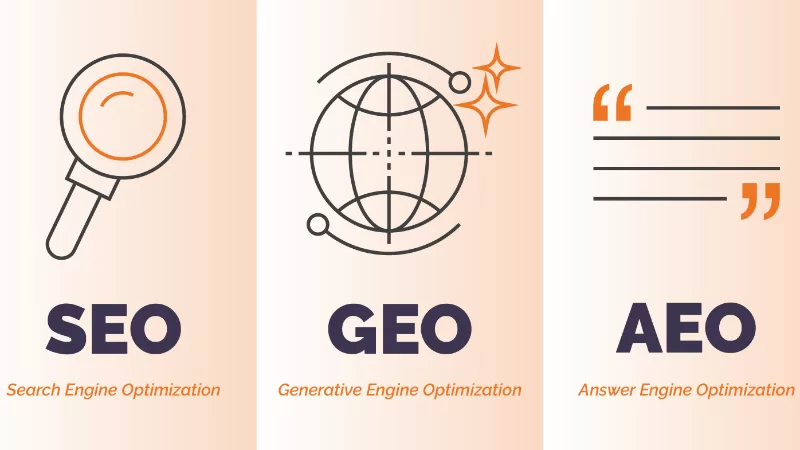
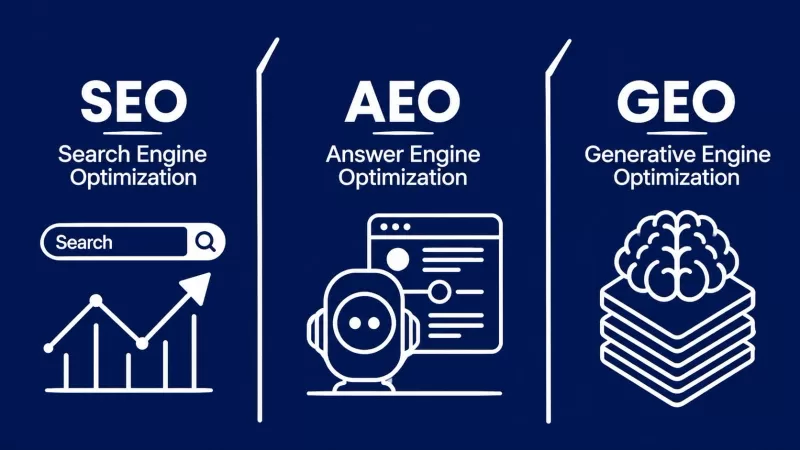
Answer Engine Optimization (AEO) is the practice of formatting web content so search engines and voice assistants can extract immediate, self-contained answers—typically through question-based headings paired with concise definitions or structured lists. Generative Engine Optimization (GEO) focuses on increasing the likelihood that large language models like ChatGPT, Gemini, or Perplexity cite and recommend your brand inside synthesized responses.
Traditional SEO remains the foundational umbrella covering crawlability, content relevance, and domain authority. The distinction lies in the primary goal: SEO targets page rankings, AEO targets direct answer extraction, and GEO targets brand citations within conversational AI outputs.
Are they completely separate disciplines? In its May 2026 guidance on generative search, Google clarified that optimizing for AI features on Google Search still relies on core SEO principles and existing quality systems. However, standalone AI platforms evaluate citations differently, making cross-platform testing essential.
My Mini Test: Google vs. an AI Tool
Star section. Replace every yellow bracket with your own real observation. Do not paste AI-generated results, and verify anything the AI tool told you.
I tested the exact same local search query on two platforms on [date]: [your exact question, e.g., Best digital marketing course in Dhaka with practical projects?]
What I checkedGoogleAI tool: [name]Format of the answer[describe: AI Overview? organic links? local map pack?][describe: structured summary? bullet list? step-by-step?]Sources shown[which websites or directories appeared][which sources were cited, or none]Did I need to click to get my answer?[yes/no, and explain why][yes/no, and explain why]Was the Bangladesh information correct?[what local details I verified][what local details I verified]Was my own or a local site mentioned?[yes/no][yes/no]Key takeaway from this test[1-2 sentences on how this shapes my SEO plan][1-2 sentences on how this shapes my GEO plan]

Written by
Md.Alamin Sarkar
Comments (0)
No comments yet — be the first to share your thoughts.