AI search is changing how people discover information online. Instead of showing only a list of links, AI-powered search can interpret detailed questions, summarize information and point people to relevant sources. This may reshape website traffic and visibility, but it does not make SEO obsolete. Websites still need to be crawlable, useful, trustworthy and easy to navigate. The strongest approach combines sound SEO fundamentals with clear answers, original insight and a genuinely helpful experience.
Search is becoming more conversational
Think about the last time you searched online. You may have typed a few keywords, opened several websites and compared the information yourself. Now you can also ask a longer question in everyday language and receive a summarized response. That is one of the major changes behind AI-powered search.
Imagine someone in Dhaka who wants to start a small online clothing business. They might ask, “What do I need to start selling clothes online in Bangladesh, and how can I attract my first customers?” A traditional search engine may show separate pages about business setup, product photography, delivery and marketing. An AI search experience may organize several of those topics into one answer and provide links for further reading.
This is convenient for users, but it creates a challenge for website owners: how can a business remain visible when people increasingly receive answers on the search page? The answer is not to abandon SEO. It is to build on SEO by publishing information that people—and search systems—can understand and trust.
1. What Is AI Search, and How Does It Work?
AI search uses artificial intelligence to interpret questions and help people find relevant information. Unlike a simple list of matching pages, an AI-powered experience may interpret the meaning behind a question, consider its context and generate a summarized response. Some experiences also display links to sources.
Understanding the question
AI systems can often connect related questions in a conversation. For example, someone may ask, “How can I get more customers for my small business?” and then follow up with, “Would Facebook Ads or Google Ads be better?” The earlier question can provide context for understanding the next one.
Finding and organizing information
Some AI systems use a process known as Retrieval-Augmented Generation (RAG). In simple terms, a system retrieves relevant information from available sources and uses it to help produce an answer. The exact process differs between products. AI-generated answers can still contain mistakes or outdated details, so important claims should be checked against reliable, original sources.
2. Traditional Search vs. AI Search
Both traditional search and AI search help people find information, but the experience can differ. Traditional search commonly presents a list of pages for users to open and compare. AI search may provide a direct summary, sometimes with links to supporting sources.
AreaTraditional searchAI-powered searchTypical resultA ranked list of website linksA generated summary, sometimes with source linksUser journeyThe user opens and compares pagesThe user may get an overview before visiting a siteQuery styleOften short keywords or phrasesCan handle detailed, conversational questionsVisibilityRankings and clicks are key signalsRankings, citations, mentions and useful visibility may all matterContent opportunityHelp the user choose a useful pageProvide reliable information that can support an answer
AI features do not appear for every search, and many people still want to visit websites to compare services, read detailed guides or make a purchase. Businesses should prepare for both experiences rather than assuming one will replace the other. Google explains how AI features such as AI Overviews and AI Mode relate to websites.

3. How AI Search Is Changing the Future of SEO
3.1 Website traffic may become less predictable
When a search feature answers a simple question immediately, some users may not need to click through to a website. This can affect clicks for certain informational searches. However, people researching a service, comparing products or looking for detailed instructions may still need the original website.
Businesses should create pages that offer more than a brief definition. Include practical steps, comparisons, examples, product details and clear ways to contact the business. Track meaningful outcomes such as enquiries and purchases, not only page visits.
3.2 Helpful content matters more than keyword repetition
Keywords remain useful, but repeating a phrase unnaturally does not make an article valuable. A strong page answers the reader’s main question, explains related issues and gives accurate, relevant detail.
For example, an email marketing guide can explain how to build a permission-based list, write subject lines, plan a campaign and measure results—not just define email marketing. Continue with the keyword research guide and on-page SEO checklist. Internal-link note: publish these destination pages or change these URLs before launch.
3.3 Search intent is essential
Search intent is the reason behind a query. Someone searching “What is SEO?” needs a beginner-friendly definition. Someone searching “best SEO tools” may want a comparison, while “SEO services for small businesses” may indicate that the person is considering hiring a provider.
Each page should match the need behind the query. A reader looking for a basic explanation should not land on a page that immediately pushes a sales offer. Start with the SEO basics guide. Internal-link note: publish this destination page or change the URL before launch.
3.4 Original information helps a business stand out
Many websites repeat the same general tips. A more useful article adds something distinctive: a real project example, a clear process, original photographs, expert commentary, first-hand observations or carefully explained results.
For example, a guide for a Dhaka cleaning company could show how to organize service pages, keep its Google Business Profile accurate and make it easy for customers to request a quotation.
3.5 Trust and transparency support long-term visibility
Readers need to know who is behind a website and whether its claims are dependable. Explain services honestly, identify authors where appropriate, cite reliable sources and avoid unsupported promises. If a business publishes a case study, it should explain what work was done and how results were measured.
Google’s guidance on creating helpful, reliable, people-first content recommends assessing whether content is original, useful, accurate and made to help people.
3.6 Visibility is broader than a blue-link ranking
A page’s position in traditional search remains important, but users may also discover a business through a source link or mention in an AI-generated response. There is no guaranteed method to make an AI tool mention a particular website. The practical goal is to publish accurate, accessible and genuinely useful information.
4. AEO and GEO: What Do They Mean?
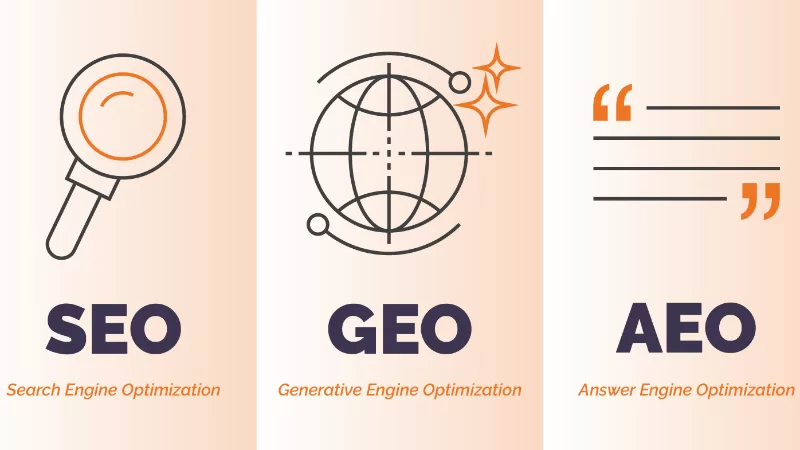
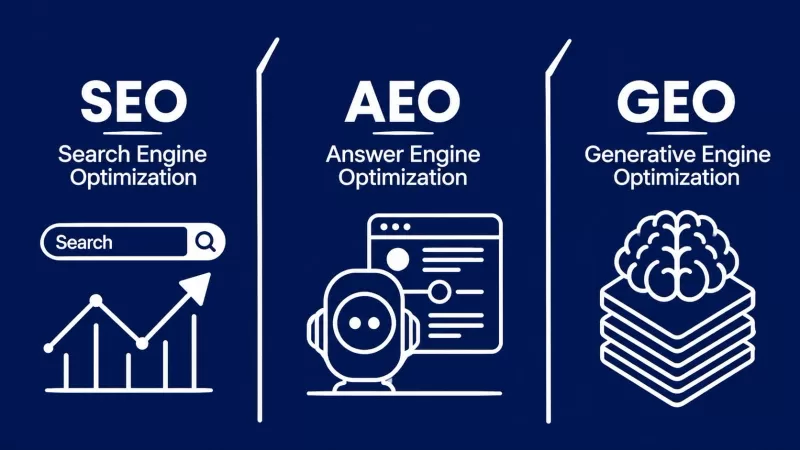
Two terms often discussed alongside AI search are Answer Engine Optimization (AEO) and Generative Engine Optimization (GEO). They describe related approaches to making information easier for answer-focused and generative systems to understand. They do not replace SEO.
Answer Engine Optimization (AEO)
AEO focuses on answering users’ questions clearly. A page about local SEO, for example, can begin with a concise definition and then explain how local businesses can improve their online presence. Question-based headings, direct explanations and useful supporting details can make the page easier to understand. Continue with the local SEO guide. Internal-link note: publish this destination page or change the URL before launch.
Generative Engine Optimization (GEO)
GEO focuses on making content clear, relevant and dependable for generative AI experiences. Useful structure, specific explanations, original insights and trustworthy references can help systems interpret the subject. There is no guaranteed checklist that secures inclusion in a generated answer.
ApproachMain focusUseful content practicesSEODiscoverability in search enginesTechnical accessibility, relevant content, links and user experienceAEOClear answers to user questionsQuestion-led headings, concise answers and helpful explanationsGEOUnderstandable content for generative systemsReliable detail, clear structure, original insights and sources
Think of SEO as the foundation. AEO and GEO are useful ways to think about how that foundation can serve people who use direct-answer and generative search experiences.

5. A Mini Test: Ask Google and an AI Tool the Same Question
A simple experiment can make the difference between search experiences easier to understand. Choose one question, ask it on Google and in an AI tool on the same day, and record what each platform actually shows.
Suggested question: “What should a small business in Dhaka do to improve its online visibility?”
What to compareGoogle SearchAI tool (write its name)Answer formatRecord what appearedRecord what appearedSources or links shownList the sources you sawList the sources you saw, or write “none”Did you need to click?Explain whether and whyExplain whether and whyWas the Bangladesh-specific information accurate?Verify and recordVerify and recordWas a local business or website mentioned?Yes/no and exampleYes/no and example
Your observation: Write what genuinely surprised you after completing the test. Do not copy a generated answer.
What this means for SEO: Explain, in your own words, what the comparison suggests about website visibility, source links and the value of useful content.
Important: This is a worksheet template, not a report of a test that has already been completed. Add the actual test date, tool name, observations and genuine screenshots before presenting it as research.
Screenshot placement — only after the test has been performed Suggested filename: mini-test-google-vs-ai.png Alt text: Side-by-side screenshots showing the same search question entered into Google and the selected AI tool.
6. How to Prepare Your Website for AI Search
Understand your audience
List the questions customers ask before buying. Review enquiries, customer comments, search suggestions and relevant community discussions. Use those questions to plan useful pages.
Use keywords naturally
Place the main topic in the title, introduction and relevant headings. Include related phrases where they fit. Avoid keyword stuffing and write in the language your audience uses.
Create a clear page structure
Use one clear H1 for the page topic, H2 headings for major sections and H3 headings for supporting points. Make each heading describe the information that follows.
Answer common questions directly
Start with a straightforward answer, then add context, examples and next steps. A page about Shopify SEO, for instance, could answer questions about product titles, descriptions, page speed and indexing.
Add practical examples and first-hand insight
Show how advice works in a real situation. For a local service business, explain how a relevant service page can describe the location served, the work included and how customers can request help.
Build useful internal links
Connect related pages with descriptive anchor text. A beginner SEO guide might link to separate resources on keyword research, on-page SEO, technical SEO and link building. Use links that help the reader continue learning rather than adding links solely for SEO.
Use reliable external sources
Link to original documentation when explaining platform features or technical requirements. Avoid unsupported statistics and websites that promise guaranteed rankings.
Keep the website technically healthy
Make important pages accessible to crawlers, use HTTPS, maintain a useful sitemap and ensure pages work well on mobile. Use Google Search Console to review indexing and technical issues. Its Performance report can help you monitor search impressions, clicks and queries. See the technical SEO checklist for a practical review. Internal-link note: publish this destination page or change the URL before launch.
Check AI crawler access carefully
Different services use different crawlers for different purposes. OpenAI documents OAI-SearchBot for search discovery and GPTBot for a separate model-training purpose. These controls are distinct. Review the official OpenAI crawler documentation before changing robots.txt rules; do not assume one crawler setting controls every use.
Refresh content and measure outcomes
Update outdated details, replace broken links and improve weak sections. Monitor impressions, clicks, queries and indexing in Search Console. Use analytics to understand enquiries, purchases and other meaningful actions. Continue with the Google Search Console guide. Internal-link note: publish this destination page or change the URL before launch.

7. Practical Example: A Clothing Business in Dhaka
Imagine a small online clothing shop in Dhaka. It has a website, but its product pages contain only short descriptions and customers cannot easily find delivery, exchange or sizing information. The owner wants to attract more customers through search.
1.Start with customer questions. List questions such as: What sizes are available? How long does delivery take in Dhaka? Can an item be exchanged? How should the fabric be cared for?
2.Improve product pages. Write accurate descriptions that explain fabric, fit, available sizes, care instructions and product details. Avoid using one generic description for every item.
3.Publish useful supporting content. Create guides such as “How to Choose the Right Dress Size” and “How to Care for Cotton Clothes.” Make sure each guide answers a real customer question.
4.Strengthen SEO basics. Use descriptive page titles, clear headings, relevant keywords, descriptive image alt text and useful internal links. Check that the website is easy to use on a phone.
5.Make trust easy to verify. Show accurate contact details, delivery and exchange policies, genuine product photographs and authentic customer reviews. Track which pages lead to enquiries and orders.
The lesson is simple: preparing for AI search is not mainly about adding an AI tool to a website. It is about making the business’s information more complete, useful and trustworthy for customers. Readers looking for hands-on support can explore the digital marketing services page. Internal-link note: publish this destination page or change the URL before launch.
8. Benefits and Challenges of AI Search
Potential benefitsPotential challengesUsers may find an overview more quickly.Some searches may generate fewer website clicks.Conversational questions can be easier to ask.A website’s inclusion in an AI answer is not guaranteed.Source links can introduce users to new websites.AI answers can be incomplete or inaccurate.Businesses have new opportunities to demonstrate expertise.Website owners have limited control over how their content is summarized.The shift encourages clearer, more useful content.Measuring visibility across different AI tools can be difficult.
AI search can make information easier to access, but it also raises questions about traffic, accuracy and attribution. Businesses should treat it as one part of a wider discovery landscape—not as their only source of visitors.
9. Frequently Asked Questions
Is SEO still important with AI search?
Yes. Search systems still need to discover, access and understand web content. Helpful content, technical accessibility, clear site structure and a good user experience remain important.
Will AI search replace Google?
AI is changing search experiences, and Google itself offers AI-powered features. However, people still use websites for detailed research, product information, comparisons and services.
Traditional and AI-powered search can coexist.
What is the difference between AEO and GEO?
AEO emphasizes clear answers to users’ questions. GEO emphasizes making content useful and understandable in generative AI experiences. Both complement broader SEO work.
How can I improve my website’s visibility in AI search?
Build on SEO fundamentals: publish original and useful information, answer relevant questions, use clear headings, maintain technical accessibility and cite reliable sources. No tactic can guarantee that an AI system will mention your site.
Do keywords still matter?
Yes. Keywords help communicate a page’s topic, but they should be used naturally. Focus on the subject and the reader’s intent rather than repeating an exact phrase.
Does AI-generated content automatically hurt SEO?
Not automatically. The important issue is whether the final content is accurate, helpful and created for people. Review AI-assisted drafts, verify facts, add original insight and avoid publishing large amounts of low-value material.
Conclusion: Build a Website Worth Discovering
The future of SEO is not simply a contest to place more keywords on a page. AI search is changing how people ask questions, receive information and discover websites. That shift may affect traffic and create new forms of online visibility, but it does not remove the need for strong SEO.
For businesses in Bangladesh, the practical path is clear: understand customers, answer their questions, share original examples, keep technical foundations healthy and make every important page trustworthy and easy to use. A website cannot demand a place in an AI-generated answer. It can, however, become a source that people find useful enough to read, trust and recommend.
Search technology will continue to evolve. Businesses that keep learning and consistently serve their audiences will be in a stronger position to adapt.
References
•Google Search Central — AI features and your website
•Google Search Central — Creating helpful, reliable, people-first content
•Google Search Central — SEO Starter Guide
•OpenAI — Overview of OpenAI Crawlers
Editorial and publishing notes
•Complete the mini test yourself. Add its real date, the exact question, the tool name, genuine observations and screenshots. Do not publish template prompts as completed findings.
•The internal URLs in this draft are suggested destinations. Create the linked pages or replace the paths with existing live URLs before publishing.
•Verify that each external source supports the nearby claim and revisit platform documentation before making technical changes.
•Add the real author name, reviewer details and publication or update date if these are available. Do not claim checks or first-hand experience that did not occur.
•Run a final grammar and plagiarism review, and confirm the publisher’s formatting and submission requirements.
Written by
Saifullah
Comments (0)
No comments yet — be the first to share your thoughts.