Beyond Google: How AI Search Is Changing the Future of SEO
Imagine searching Google for "Which digital marketing course in Dhaka is suitable for a beginner?" Instead of opening multiple websites, you receive an AI-generated summary containing explanations, recommendations and links to relevant sources.
This is how search is evolving. Artificial intelligence is transforming the way people discover information, interact with search engines and make online decisions.
For years, Search Engine Optimization (SEO) focused primarily on improving website rankings, attracting organic traffic and targeting relevant keywords. However, AI-powered search experiences are introducing a new dimension: websites can now contribute to AI-generated answers even when users do not directly visit them.
For businesses, digital marketers and content creators, this transformation raises an important question: If AI can answer users directly, what happens to traditional SEO?
The answer is simple: SEO is not disappearing. Its purpose is expanding.

How Is AI Changing the Way People Search?
Traditional search engines primarily organize information into ranked website results. Users enter a query, review available links and visit websites to find the information they need.
AI-powered search introduces a more conversational experience. Instead of simply displaying links, these systems can interpret context, connect information from different sources and generate summarized responses.
The Rise of AI-Powered Search Platforms
Several platforms are contributing to this transformation:
- Google AI Overviews: Provides AI-generated summaries within Google Search.
- Google AI Mode: Offers a more conversational search experience.
- ChatGPT Search: Allows users to search the web through conversational questions and access relevant sources.
- Perplexity: Combines conversational responses with cited web sources.
Although these platforms offer similar search experiences, their interfaces, retrieval processes and source-selection approaches differ.
Google also explains that its AI search experiences can use a technique called query fan-out. This approach allows a complex question to be explored through multiple related searches, helping the system identify relevant information across different subtopics.
Traditional Search vs. AI-Powered Search
The most noticeable difference between traditional and AI-powered search is how information is presented and consumed.
Traditional search generally displays a list of ranked website links. Users must explore different pages to compare information and find suitable answers.
AI-powered search, on the other hand, can generate summarized responses, provide supporting links and allow users to ask follow-up questions.
This does not mean traditional search is disappearing. AI Overviews and AI Mode are additional search experiences within the broader search ecosystem.
What Is the Impact of AI Search on SEO?
The influence of AI Search goes beyond technological innovation. It is changing user behaviour, website traffic and the way digital marketers measure online visibility.
1. Organic Traffic and Zero-Click Searches
A zero-click search occurs when users find the information they need directly on a search results page without visiting another website.
According to a July 2025 Pew Research Center study, researchers analyzed browsing activity from 900 U.S. adults in March 2025. The study found that users who encountered an AI summary clicked a traditional search result in 8% of visits, compared with 15% when no AI summary appeared. Only 1% of visits involved clicking a link within the AI summary itself.
These findings highlight a potential challenge for websites that depend heavily on informational search traffic.
However, these figures represent the study's U.S. sample and period. They should not be treated as a direct measurement of search behaviour in Bangladesh.
2. Search Intent Is Becoming More Conversational
Search behaviour is gradually moving beyond short, keyword-focused queries. Users can now ask detailed questions that communicate their actual needs and intentions.
For example:
- Traditional query: "SEO course Dhaka"
- Conversational query: "Which SEO course in Dhaka should a beginner choose if they want to start freelancing?"
The second query provides more context and reveals a clearer search intent.
For content creators, this creates an opportunity to develop articles, guides and resources that directly answer real audience questions.
3. Brand Visibility Beyond Traditional Rankings
In traditional SEO, website rankings are often considered a major indicator of online visibility.
With AI-powered search, brand visibility can also include being mentioned or cited in AI-generated responses.
For example, a digital marketing institute may have useful educational content referenced in an AI-generated answer about learning SEO, even when the user does not immediately visit its website.
However, publishing more content does not guarantee AI mentions or citations. Relevance, accuracy and credibility remain essential.
4. SEO Measurement Is Becoming More Complex
Traditional SEO reporting generally focuses on organic clicks, impressions, keyword rankings, website traffic and conversions.
AI Search introduces additional visibility considerations, including brand mentions and citations.
These metrics are not interchangeable. A brand mention does not automatically mean that a website received a visit or generated a conversion.
As a result, digital marketers need to evaluate overall visibility, referral traffic, audience engagement and business outcomes together.

Understanding SEO, AEO and GEO in the AI Search Era
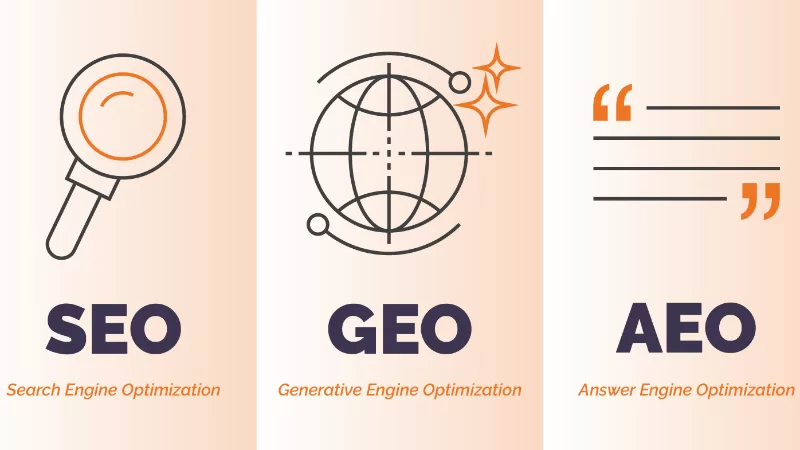
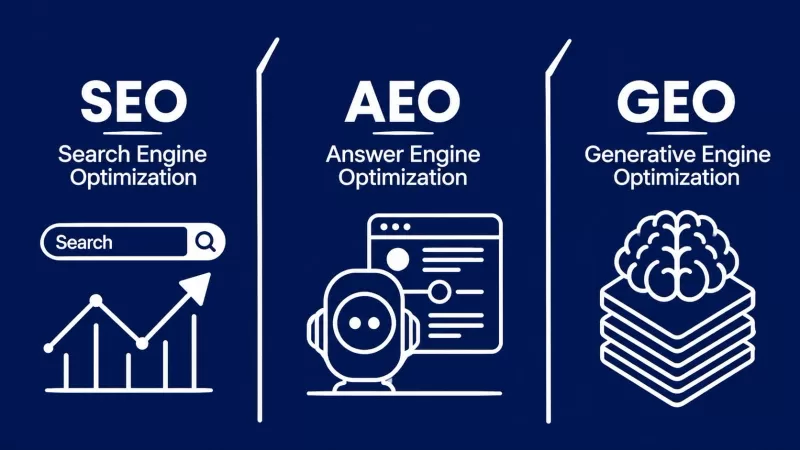
As search technology evolves, three important concepts are becoming increasingly relevant: Search Engine Optimization (SEO), Answer Engine Optimization (AEO) and Generative Engine Optimization (GEO).
What Is Search Engine Optimization (SEO)?
Search Engine Optimization (SEO) is the process of improving a website's visibility in organic search results through relevant content, technical improvements, website structure and authority.
Its primary objective is to help search engines understand website content and connect it with relevant user queries.
What Is Answer Engine Optimization (AEO)?
Answer Engine Optimization (AEO) focuses on organizing and presenting content so answer-focused systems can identify relevant information and provide direct responses to users.
For example, clearly answering questions such as "What is technical SEO?" or "How does keyword research work?" can make content more useful for answer-based search experiences.
What Is Generative Engine Optimization (GEO)?
Generative Engine Optimization (GEO) is an emerging approach focused on improving how content and brands are represented, discovered or referenced in generative AI responses.
It emphasizes useful information, relevant context, originality and credibility.
How Are SEO, AEO and GEO Connected?
Although these approaches have different focuses, they overlap.
- SEO: Focuses on organic search visibility.
- AEO: Focuses on providing clear and useful answers.
- GEO: Focuses on visibility and brand representation in generative AI responses.
These should not be treated as completely separate disciplines. Strong SEO foundations can support broader search visibility.
Google states that its generative AI search experiences continue to rely on existing Search ranking and quality systems. It does not require separate AEO or GEO markup to appear in AI Overviews or AI Mode.
Google AI Search vs. ChatGPT Search: What Should Marketers Know?
Google AI Search and ChatGPT Search offer different ways of discovering and presenting information.
Google AI Overviews and AI Mode can provide AI-generated responses with supporting links. Google also describes query fan-out as a technique for exploring related searches and subtopics.
ChatGPT Search provides conversational responses that can include links to relevant web sources.
For website owners and publishers, technical accessibility remains important.
Google's official guidance explains that websites must meet normal Search technical requirements. There is no special AI-specific structured data that guarantees inclusion in AI-generated search experiences.
Similarly, OpenAI highlights the importance of allowing OAI-SearchBot access when publishers want their content to be eligible for discovery in ChatGPT Search summaries and snippets.
However, crawler access does not guarantee that a page will be selected or cited.
The practical takeaway is clear: businesses should optimize for people first, maintain technical accessibility, publish verifiable information and build credibility instead of relying on a single search platform.
How Can Businesses Optimize for AI Search? Five Practical Strategies
Consider a small digital marketing training institute in Dhaka that wants to reach students interested in learning SEO.
Publishing repetitive course advertisements will not necessarily answer the questions potential students have. Instead, the institute can create useful resources that address genuine learning needs.
Here are five practical strategies businesses can follow to adapt to AI-powered search.
1. Answer Real Audience Questions Clearly
Create content around specific questions your target audience frequently asks.
For example:
- What is SEO and how does it work?
- How can beginners learn keyword research?
- What is the difference between on-page and off-page SEO?
- How can a small business improve its Google visibility?
Start with a direct and accurate explanation, then provide supporting details.
Clear, well-organized content makes information easier for readers to understand and search systems to interpret.
2. Publish Original Information and Practical Experience
Generic content is easy to reproduce. Original information provides additional value and helps establish credibility.
Businesses can publish:
- Original project examples.
- Practical campaign observations.
- SEO audit findings.
- Locally relevant case studies.
- First-hand explanations and experiences.
For example, a digital marketing institute can share an SEO project completed by its students, with their permission, to demonstrate practical learning.
3. Maintain Strong Technical SEO Foundations
Even valuable content needs to be accessible to search engines.
Businesses should focus on:
- Allowing appropriate search engine crawling.
- Checking indexing through Google Search Console.
- Maintaining logical internal linking.
- Improving mobile usability.
- Organizing website content clearly.
- Fixing important technical SEO issues.
Technical accessibility helps search systems discover and understand website information.
4. Build Consistent Brand Information
Brand credibility matters across digital platforms.
Keep your website, Google Business Profile and relevant directory information accurate and consistent.
Include genuine customer reviews, service descriptions, business location and contact information.
Consistent business information helps users understand your brand and builds trust.
5. Create Content for Bangladesh's Search Behaviour
Bangladeshi users often search in English, Bangla and Banglish.
For example, someone may search for "SEO course in Dhaka", while another person may type "Dhaka te SEO shikhbo kivabe?"
Businesses should understand these natural variations and create content that addresses local audience needs without keyword stuffing.
Challenges and Risks of AI-Powered Search
Although AI-powered search creates new opportunities, it also introduces challenges that marketers and website owners should understand.
AI Hallucinations and Incorrect Information
AI systems can generate convincing answers that contain inaccurate or outdated information.
This makes content verification especially important. Businesses should check factual claims, provide reliable references and regularly update outdated information.
Website Traffic Uncertainty
Some informational searches may generate fewer website visits when users receive answers directly through search results.
Businesses should not depend entirely on organic search traffic. Building an audience through email, social media and direct customer relationships can provide additional opportunities to reach customers.
Increasing Competition for AI Visibility
As more businesses explore AI-powered search optimization, competition for visibility may increase.
However, publishing large volumes of generic AI-generated articles is not a sustainable strategy.
Google's guidance warns against scaled content created primarily to manipulate search rankings without adding value.
Originality, usefulness and accuracy should remain the priority.
Lack of Universal Measurement
Different AI platforms provide different levels of source visibility and reporting.
As a result, marketers may find it difficult to measure AI visibility using one consistent method.
A more complete evaluation should consider brand visibility, referral traffic, conversions and audience engagement together.
Frequently Asked Questions (FAQ)
Is SEO Dead Because of AI Search?
No. AI Search is changing how people discover information, but SEO remains important. Technical accessibility, helpful content, relevance and trust continue to support search visibility.
What Is the Difference Between AEO and GEO?
AEO focuses on making content useful for direct answers, while GEO focuses on improving content and brand representation in generative AI responses. Both overlap with traditional SEO.
Does AI Search Reduce Organic Website Traffic?
It can reduce clicks for some informational queries because users may find answers directly on search results pages. However, the impact varies by query, platform, industry and audience.
How Can Beginners Prepare for the Future of SEO?
Beginners should learn keyword research, search intent, technical SEO, content optimization, analytics and AI-powered search behaviour. Combining theoretical knowledge with practical website
experience is equally important.
Do Websites Need Special AI Markup to Appear in Google AI Overviews?
No. Google states that there are no additional technical requirements or special AI-specific structured data needed. Standard Search eligibility and SEO fundamentals remain important.
Conclusion: SEO Is Not Disappearing. Its Purpose Is Expanding.
The future of SEO will not be determined by who can publish the most content or repeat the most keywords. It will increasingly reward businesses that understand their audiences, communicate useful information and build lasting credibility.
AI-powered search is changing how information is discovered, summarized and presented. But behind every useful answer, there is still a need for accurate information, accessible websites and reliable sources.
For digital marketers, this is not a reason to abandon traditional SEO. It is a reason to develop a broader understanding of search.
A website should not only aim to appear on the first page of Google. It should aim to become a source worth discovering, understanding and trusting.
Because in the future of search, visibility may begin with a ranking, but credibility is what gives a brand a reason to be remembered.
References
- Google Search Central. AI Features and Your Website.
- Google Search Central. Optimizing Your Website for Generative AI Features on Google Search.
- Chapekis, A. & Lieb, A. (2025, July 22). Google Users Are Less Likely to Click on Links When an AI Summary Appears in the Results. Pew Research Center.
- OpenAI. Publishers and Developers FAQ.
- Google Search Central. Google Search's Guidance on Using Generative AI Content.
AI Assistance Disclosure
ChatGPT (OpenAI) was used to support research, keyword exploration, outlining, drafting and language organization. I am responsible for reviewing the article, checking factual claims against the cited sources, confirming that the final wording reflects my understanding and ensuring that any required personal observations are genuinely mine. No third-party article text has been intentionally reproduced. External facts, data and platform descriptions are attributed in the References section.
Written by
Mariatun Nesa
Comments (0)
No comments yet — be the first to share your thoughts.