The Future of Digital Marketing Careers: What Skills Will Marketers Need in the AI Era?
Artificial Intelligence (AI) is almost at every stage of marketing, starting from exploring business ideas, and targeting customers to understanding consumer behavior, creating content, tracking results to other marketing activities.
Beyond marketing, technological advancements, particularly AI and information processing, is transforming the world of work and changing the skills employers will need in coming years. As AI becomes increasingly integrated into different industries, demand for technology-related skills, especially AI and big data, is expected to grow. This transformation is already reshaping digital marketing careers, creating new opportunities for marketers who can adapt AI-driven tools and technologies.
However, learning more AI skills doesn’t mean you will become a better marketer; you still need to develop a combination of technical, analytical, creative, critical thinking and interpersonal skills to remain competitive. It is also important to understand that digital marketing is one of the broader marketing industry, and digital marketing skills must work alongside a wider understanding of marketing . Digital marketing itself is a skill in this marketing industry.
This raises an important question: what will the future of digital marketing careers look like, and what skills will marketers need to succeed in the AI era?
How Is AI Transforming the Marketing Industry?
Thirty years ago, marketers relied on spreadsheets to carry out their work. Today, technological advancements have introduced numerous tools that make marketing activities faster and more efficient. However, does that mean marketers now work only two days a week and spend the rest of their time doing nothing? Obviously not, Technology doesn’t necessarily mean less work; instead, it often increases productivity and expectations. If marketers were once expected to create 9 slides, they might now expected to produce 90 slides. This highlights how technological progress changes not only the way marketers work but also what is expected of them.
New marketing roles and specialized titles have emerged over the last five years, driven largely by artificial intelligence, automation, data analytics, and shifting digital ecosystems. However, AI does not affect every marketing task in the same way. While some activities can be increasingly automated, others require collaboration between humans and AI, and some still depends heavily on human involvement.
To understand these differences, the AMA used the Human Agency Scale, developed by Stanford researchers, to describe how much the Human Agency Scale (HAS) provides a framework for examining the level of human involvement required across different tasks, consists of five levels, ranging from H1, where tasks can be performed with autonomous AI use, to H5, where AI use is minimal and spontaneous human input is essential.
1. Highly affected by AI (H1–H2)
AI can perform many tasks in these marketing areas, making work faster and more automated
Examples:
Email marketing
SEO
Paid advertising
Performance analysis
Copywriting
Lead generation
Market research
Graphic design
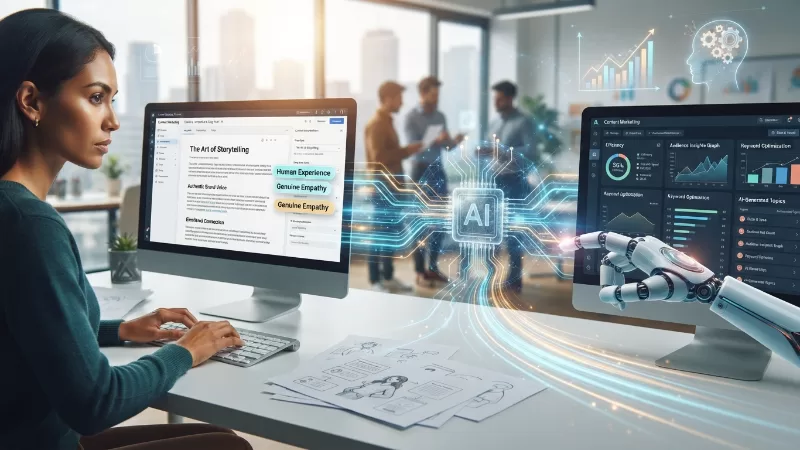
2. Human and AI collaboration (H3)
These areas require both AI assistance and human skills. AI can help with tasks, but humans are needed for creativity, understanding and decision-making.
Examples:
Content marketing
Data analysis and storytelling
Customer experience
Consumer behavior
Influencer marketing
3. Mostly human-led skills (H4–H5)
These skills depend more on human abilities, such as creativity, emotions, leadership and critical thinking. AI can provide support, but humans play the main role.
Examples:
Marketing strategy
Brand management
Teamwork and collaboration
Creativity
Critical thinking
Leadership
Emotional intelligence
Ethical decision-making
Adaptability
While AI helps identify opportunities and improve targeting, human creativity and empathy remain essential for building meaningful customer relationships.
What Skills Will Marketers Need in the AI Era?
First, let's understand what a skill is. A skill is the ability to learn something and apply that knowledge in practice.
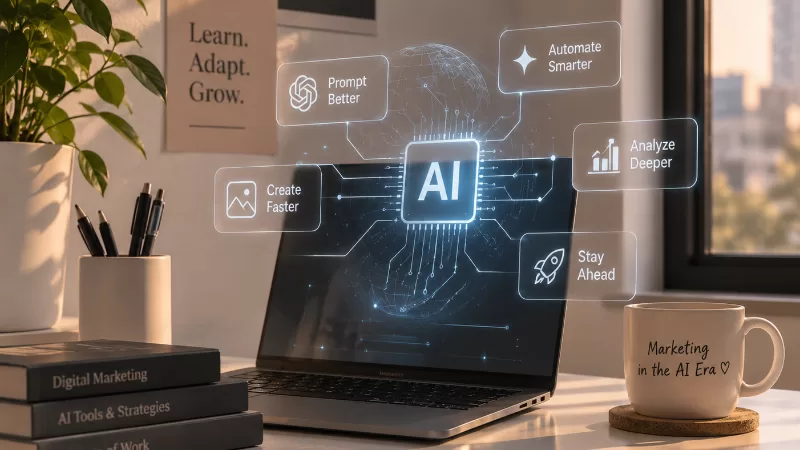
Before AI, people already needed skills to perform their jobs. Even in the AI era, skills remain essential. However, as technology evolves, new skills are emerging, and marketers need to learn how to adapt and use them effectively. The following skills will help marketers stay competitive in the AI era:
1.AI Literacy
One of the most important skills for marketers in the AI era is AI literacy: using your ideas and knowledge to ask AI the right questions, applying critical thinking to communicate with AI, and evaluating and correcting its output. For example, consider two marketers. Marketer A asks AI to generate keywords and follows them blindly without checking them. Marketer B asks AI to generate keywords with low search volume, then evaluates the keywords and checks their search volume before using them. Marketer B will clearly be more valuable.
AI literacy doesn’t replace your existing skills; it makes them more powerful. It’s the ability to recognize, use and evaluate AI technologies.
2.AI Automation
AI automation combines AI technology with marketing software to automate repetitive tasks, understand customer behavior, monitor campaign results and improve marketing campaign. It helps with automated email marketing, customer support chat bots, target advertising, campaign performance analysis, lead generation and follow ups. Some examples of automation are: Higgsfield AD MULTIPLIER , which is an AI tool that turns one video ad into multiple variations while keeping its original style and timing. It’s a skill not a feature. Then, in digital marketing anyone who struggles with SEO, AEO and GEO, this AI marketing automation helps in many ways, which is SEMrush MCP server. There are many more automation like these which are very useful skills.
3. SEO and Digital Marketing
A strong foundation in digital marketing remains valuable as businesses continue to compete for online visibility. Important skills include keyword research, on-page and technical SEO, off-page SEO, competitor analysis, paid advertising and performance tracking.
4. Content and Creative Skills
Although AI can generate content, original ideas, creativity and effective communication still require human direction. Marketers should develop content writing, copywriting, storytelling, content strategy, graphic design and brand communication skills.
5. Analytical and Strategic Thinking
Modern marketers need to understand data, recognize market trends and make informed business decisions. Skills such as critical thinking, problem-solving, market research, consumer behavior analysis, quality control and strategic planning help professionals evaluate information rather than simply relying on AI-generated results.
6. Human and Interpersonal Skills
Skills involving human understanding and relationships remain important in marketing. Communication, leadership, collaboration, emotional intelligence, adaptability, influence and relationship building help marketers connect with audiences, work with teams and build trust.
7. Business Understanding and Decision-Making
Marketing is not just about creating content or promoting products; it also involves understanding business goals. Professionals should develop business acumen, decision-making abilities and the confidence to work through uncertainty. These skills help connect marketing activities with customer needs and overall business performance.
Conclusion
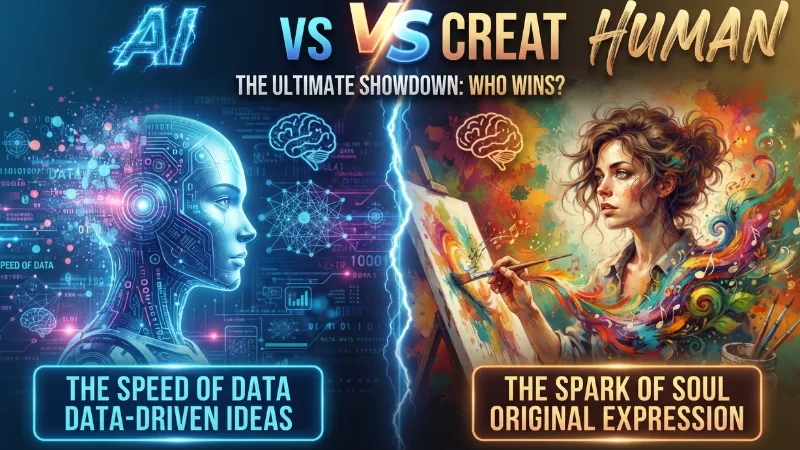
AI didn’t replace marketers, instead it has created more opportunities for the marketers to succeed, and they need to learn new skills in order to succeed. Therefore, it is important to identify true artists, differentiators, and innovators, and strategically reskill them to use AI. When people over-rely on generative AI, the collective divergence of ideas drops by 40%, according to a Harvard study. I believe that today we have more ideas, scripts, content, and advertisements, which may lead to overload. Effective marketing combines emotional intelligence, consumer understanding, product innovation, and strategic communication. While AI helps identify opportunities and improve targeting, human creativity and empathy remain essential for building meaningful customer relationships. Digital marketing is changing, and AI is becoming a big part of that change. But I don't think the future is just about who knows how to use the most AI tools. It's about who understands marketing, thinks creatively, asks the right questions, and knows how to turn information into meaningful results. AI can make our work easier and faster, but the ideas, decisions, and understanding behind that work still matter. We don't need to compete with AI; we need to learn how to work with it. After all, the goal isn't just to keep up with technology but to keep growing with it.
Frequently Asked Questions
1. What skills will marketers need in the AI era?
Marketers will need a combination of AI literacy, automation, digital marketing, SEO, content creation, analytical thinking, creativity, communication, leadership, and strategic decision-making skills to remain competitive.
2. How is AI changing the digital marketing industry?
AI is transforming digital marketing by automating repetitive tasks, improving customer targeting, analyzing consumer behavior, generating content, tracking campaign performance, and helping marketers make data-driven decisions.
3. Will AI replace digital marketers in the future?
AI is unlikely to replace all digital marketers. While it can automate certain tasks, human creativity, critical thinking, emotional intelligence, leadership, and strategic decision-making remain important for successful marketing.
4. What is AI literacy in digital marketing?
AI literacy is the ability to understand, use, communicate with, and evaluate AI tools effectively. It involves asking the right questions, providing clear instructions, identifying errors, and checking AI-generated results before using them.
5. Why is AI automation important for marketers?
AI automation helps marketers save time by handling repetitive tasks such as email marketing, lead generation, customer support, follow-ups, and campaign performance tracking. It allows marketers to focus more on strategy and creative work.
6. Is SEO still an important skill in the AI era?
Yes. SEO remains an important digital marketing skill because businesses still need online visibility and relevant organic traffic. Understanding keyword research, technical SEO, on-page SEO, off-page SEO, and competitor analysis helps marketers build effective strategies.
7. What human skills are important for digital marketers?
Important human skills include creativity, communication, leadership, critical thinking, emotional intelligence, adaptability, collaboration, problem-solving, and relationship building. These skills help marketers understand people and build meaningful customer relationships.
8. Do marketers need technical skills to work with AI?
Yes. Understanding AI tools, marketing automation, data analytics, SEO tools, and digital marketing platforms can help marketers work more efficiently. However, technical knowledge should be combined with analytical, creative, and interpersonal skills.
9. What is the difference between AI skills and traditional marketing skills?
AI skills involve understanding and using artificial intelligence, automation, and related technologies. Traditional marketing skills focus on understanding customers, developing strategies, communicating value, creativity, and building relationships. Modern marketers need both.
10. How can beginners prepare for a digital marketing career in the AI era?
Beginners should start by building a strong foundation in digital marketing, learning SEO, content creation, keyword research, and data analysis. They should also develop AI literacy, explore automation tools, practice critical thinking, and continuously adapt to new technologies.
Written by
Ishbilya
Comments (0)
No comments yet — be the first to share your thoughts.