

Local lead generation is attracting nearby customers who are interested in buying. Ultimately, converting them to paid customers via calls, form fills, or walk-ins. A local customer picks up their phone and searches for your service. They will either find your business or your competitor. Local lead generation helps people find you first. That means more calls, more leads, and more customers.
Here is why it matters. Google’s research shows that 76% of mobile users searched for something nearby. They ended up visiting a relevant business within 24 hours of their search [1]. These are not ordinary users; they are local buyers, ready to purchase, and waiting for the right moment to make a decision.
Yet, the majority of local businesses do nothing about it. They rely on word of mouth and irregular social media posts, trying to entice customers by any means necessary. However, attracting local clients requires a well-thought-out strategy. It has some particularities that traditional marketing does not have. And local lead generation tactics will help you get more customers in 2026.
The following guide will provide an overview of the definition and differences from other marketing approaches. It also includes methods for local lead generation. Whether you want more local customers or want to help your clients, this guide is for you. It shares simple ways to get more local leads.
What Is Local Lead Generation?

Local lead generation helps people in your area find your business. It makes it easy for them to learn about your services and contact you. The word “local” is the key factor here, which differentiates one from the other. In other words, a local lead is not some random person that you have no idea where they are from. But rather someone near you who is interested in your services or products. You are trying to reach the people close enough to become customers.
A local lead could be someone calling your office or filling out a form on your website. They may contact you through social media or email, and even visit your premises. They are a potential customer in your town who needs what you sell and is ready to act.
How local lead generation differs from general lead generation
General lead generation casts a wide net. It tries to reach anyone who might buy, no matter where they are. That works for online businesses that ship everywhere or sell software worldwide.
Local lead generation is the opposite. It is narrow on purpose. A plumber in Columbus does not care about a homeowner in Texas. They care about the street two blocks over. So the whole approach shifts toward local intent, which simply means the searches people make when they want something nearby. Think plumber near me or the best bakery in town. When you focus on generating local leads, you stop competing with similar service providers available online. And start competing in the vicinity of your business, which is a far easier fight to win.
What a local lead looks like for a service business
Picture a phone repair shop as I run Google ads for them. A local lead is the person who searches for “cracked screen repair near me,” sees the shop at the top of the results, and taps to call. That single tap is a business lead worth real money.
For a service business, local leads usually arrive in one of four ways. A phone call. A contact form. A direct message. Or a walk-in. Each one is a potential customer raising their hand. So, your job is to make sure they can find you and reach you with as little friction as possible.
Why local businesses underestimate their lead potential
Many local business owners assume the demand around them is small. It rarely is. In fact, people search for local services constantly, every day, in every town. The leads are already out there. The only question is whether your business is positioned to be found when those searches occur.
Most competitors would say they do, but their listings are outdated. Their websites lack a mobile-friendly design, and they never ask for reviews. That gap is your opportunity. When you take local lead generation seriously, and they do not. Then you capture the local leads they are leaving on the table.
Why Local Lead Generation Works Differently from General Lead Gen
Local lead generation is not just general marketing with a smaller map. The whole game changes when your customers are nearby. The way people search, the way they choose, and the tools that help them do both are all different. Knowing why allows you to stop wasting time on tactics that work on a national level but not in your local market.
Geographic intent changes everything
When someone runs a local search, they are usually close to buying. A person who types emergency electrician near me is not researching for fun. They have a problem right now and want someone nearby to fix it.
This is local intent, and it is the single biggest reason local leads convert so well. The search itself signals urgency and readiness. General searches are often about gathering information. Local searches are about taking action. That is also why the numbers are so strong. Many people use their phones to search for local businesses. According to the research conducted by Google, 88% of them call or visit a business within 24 hours [2]
The local search trend makes your business a step closer to the customer. Because it appears right when they are looking for someone like you.
Trust works differently in a local context
By contrast, A national brand builds trust through size and advertising. Local businesses can rely on boosting their presence in local searches to gain the trust of nearby customers. It can be done by providing evidence of their physical location. Local audiences want to see recent reviews from their region, pictures of the business, and an address they can recognise.
Besides, the tendency is great for local businesses because you do not need to invest heavily in advertising. To gain the trust of local customers, you have to provide an honest opinion about your business and maintain the information up-to-date. Local businesses compete with big corporations by brand image and provide goods or services they can rely on. Which is often easier to build when you operate near your customers.
The tools and channels that matter most are local-specific
General lead generation leans on broad tools like nationwide ads and wide social media campaigns. Local lead generation uses a different toolkit, built to help nearby people find your business.
Your Google Business Profile is the centre of it. Local directories, local keywords, and local targeting ads dominate in terms of volume. So a search engine like Google that uses these signals to identify relevant businesses for local searches. It will prioritise those who employ them more frequently and thoroughly. This is why a company that focuses on a few local channels can expect to get better results than one that tries to use everything available.
The Foundation: Get Your Local Online Presence Right First
Before you start trying any fancy tactics, the first thing you have to do is to build the foundation. Many local business owners neglect this step and consequently wonder why nothing works for their local lead generation. This step may seem boring, but it is essential. Three things make up that foundation.

Your Google Business Profile needs to be complete and current
The Google Business Profile, formerly known as Google My Business. It is the free listing that appears when someone searches for a particular service on Google and Google Maps. For most local businesses, this is the most important lead generation channel. Because it determines whether your business will appear in the local search results.
Moreover, it is important to build a complete profile because a complete profile usually ranks higher in the search results. This means that you have to fill out all fields and categories. Then provide your schedule, list the services you offer, and upload photos of your work and the inside of your business.
Besides, the Google Business Profile should be actively maintained. You can post short updates every now and then. Google loves active and complete profiles and rewards them with higher positions in the search results.
In addition, a well-optimised Google Business Profile often beats paid listings by simply appearing earlier in the search results.
Your name, address, and phone number must match everywhere
This one may seem small, but it can have a big impact on your local search rankings. Use the same business name, address, and phone number everywhere. Keep this information the same on your website, Google Business Profile, and business directories. This helps Google trust your business information. It can also improve your local search rankings.
In other words, don’t have different phone numbers or addresses listed on Google versus Yelp versus your own website. Choose one specific format for your NAP and go with it. It won’t cost you anything to make these changes. And it could dramatically improve your presence in local searches.

Your website needs a clear local signal
Your website should always make it clear where you are located and what town you serve. Having a national presence without specifying the region is bad for both your customers and Google.
Use your city or service area name on your homepage and any other relevant landing pages for your local service. Add keywords that are popular local searches in your area, for example, roofers Columbus. Display a Google map of your location as well. Always make sure to include your NAP (name, address, phone number) in the footer section of your web pages. These local SEO tips will help you appear in local searches and get more local customers.
7 Local Lead Generation Strategies That Work in 2026
Once your foundation is solid, these are the local lead generation strategies that bring in steady leads. You don’t need all seven. Get the first two up and running, and then add on as you go. All of these are about reaching your local area to market your business.
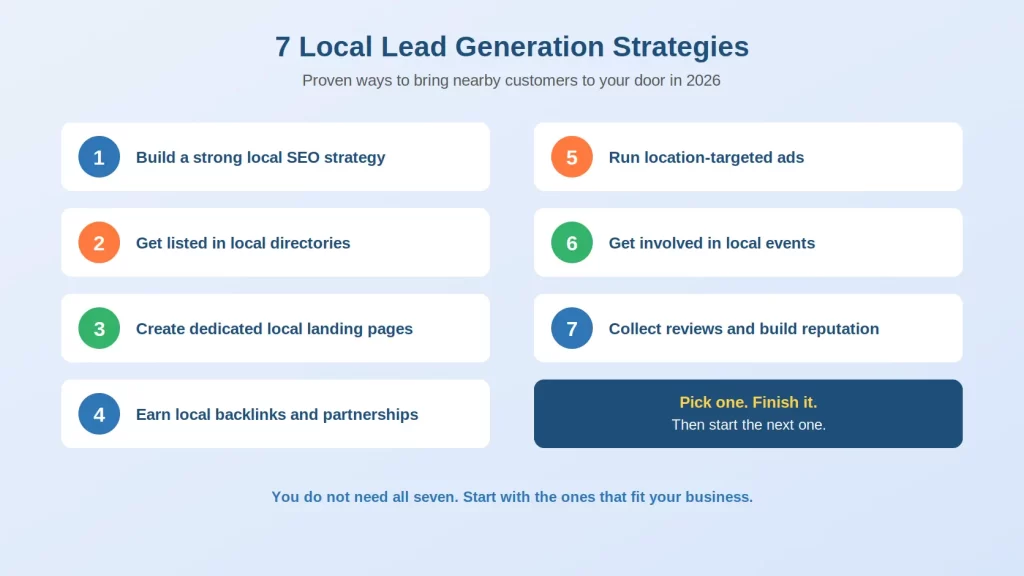
1. Build a strong local SEO strategy
Local search engine optimisation, or local SEO, is the work of making your business show up when nearby people search for what you offer. It is the highest-value long-term strategy on this list because the leads it brings are free and keep coming.
A simple local SEO strategy has three parts. Keep your Google Business Profile active. Use local keywords on your website. Earn reviews steadily. That should put you higher in the local search results than some competitors who’ve been around longer.
2. Get listed in local directories
Local directories are sites like Yelp and your chamber of commerce. Also, other directories that categorise businesses by type and location. Each accurate listing is both a place customers find you and a trust signal to Google.
First, claim your listing on the main directories that fit your trade. Keep your NAP identical on every one. These listings also create local backlinks, which are links from other local websites back to yours. Backlinks tell the search engine your business is established and trusted in the area.
3. Create dedicated local landing pages
If you plan to serve multiple towns, create a landing page for each one. A landing page is a page on your website that has one goal: to capture a lead. A page titled drain cleaning in Dublin will beat a generic services page for anyone searching in Dublin.
Each local landing page needs to identify the region, describe the service, and showcase testimonials. You should include a low-effort lead-capture form.
Only collect information necessary to follow up on their request: name, phone number, and the scope of work. The more specific the landing page is to the searcher’s location, the more local leads you’ll be able to collect.
4. Earn local backlinks and partnerships
Securing backlinks from other local sites is another great way to improve your search engine optimisation. They tell Google your business matters in the community.
Form partnerships with other local businesses that serve the same customers without competing. A plumber and an electrician can refer work to each other and link to each other’s sites. A company that hosts or sponsors a local team or event often gets a backlink from that team or organisation’s website. Backlinks from local sources are often harder to come by than national ones, meaning local links can pack more SEO value.
5. Run location-targeted ads
Local search engine marketing (SEM) is a method of buying ads that appear when someone searches for your service. SEM makes it possible to advertise to a local audience. Google Ads, for example, allows you to bid on keywords relevant to your business and shows your ad to people who searched for those terms in your area. Local SEM can generate leads much faster than SEO.
Instead, keep your local campaigns tight. Target one service and one area at a time. Then send every click to a matching local landing page, not your homepage. Watch your cost per lead and adjust. A small focused budget is far more effective than a big unfocused one, so it is important to invest heavily in the right place.
6. Get involved in local events and networking
Not every lead comes from a screen. A good and cheap way of promoting a service-oriented business is to organise or participate in local events. Host a market, sponsor a charity race or a local fair, offer people a friendly face to recognise in the marketplace.
Moreover, it is a good idea to network locally. Members of local business groups and associations can provide a constant flow of referrals. Another great way to promote your business is to find a local influencer in the area and cooperate with him. All these methods will help you become better known and enable people to leave reviews about your business.
7. Collect reviews and build your local reputation
In fact, reviews are one of the most powerful local lead generation tools you have. People trust other customers in their area far more than they trust any advert. A business with recent, genuine reviews wins the call over one with none.
So, ask every happy customer for a review right after the job. Send a direct link so it takes seconds. Also, respond to every review, good or bad. Constant fresh reviews will help you to dominate local searches. Both of them drive traffic and capture leads from prospective customers.
How to Turn Local Traffic into Actual Leads
Keep in mind that many local businesses rank well and get traffic but do not receive any phone calls. The gap between traffic and leads is where most local lead generation quietly fails. Closing that gap is often the fastest win available to you.
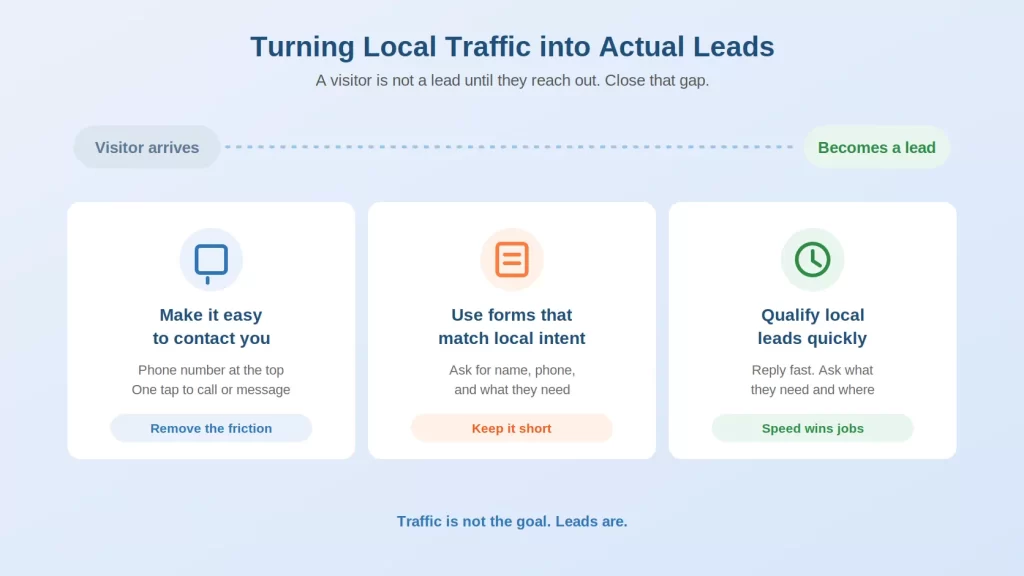
Make it easy to contact you
Anytime someone leaves your website is a lost lead. One reason they might have left is because contacting was a problem, so your phone number should be at the top of every web page and clickable on mobile. Also, consider putting a contact form on your website or landing pages. Your operating hours should also be easy to find. The easier you make it, the more potential customers turn into real local leads. This is the cheapest improvement in all of lead acquisition, because it costs nothing and uses the traffic you already have.
Use lead capture forms that match local intent
A lead capture form is the box on your site where a visitor types their details to get in touch. The best lead capture forms are short and match what a local searcher actually wants.
Once more, only ask for the necessary information. A name, phone number, and a sentence or two about the position are sufficient. Each additional field you add may cause a drop-off in sign-ups. Place a form on every local landing page, right where the visitor is already interested. A clear button helps too. ‘Get a Free Quote’ works far better than a vague ‘Submit’ request. The goal is to make saying yes feel effortless.
Qualify local leads quickly
Not every lead is a good lead, and that’s okay. Qualifying leads merely means determining, sooner rather than later, whether or not the lead is a good fit for your business. It doesn’t have to be anything fancy or complicated. It just helps you save time and energy by knowing early on whether a particular lead is worth pursuing.
Asking a couple of simple questions can help you determine this. Were they a local lead? Do they need what you’re offering? Is there a timeframe for them to decide? For most local businesses, a simple call or a two-question form will suffice. You don’t necessarily need an intricate software system to qualify leads as well. You need to separate the good from the bad and know which local leads are worthy of your time and effort.
Local Lead Generation for Marketing Agencies
If your business focuses on local lead generation services for other companies rather than your own, the dynamics change. The same principles apply, but the challenge is in educating and reassuring clients. You have to keep them engaged throughout the process.
After all, satisfying these local business owners is key to keeping their long-term loyalty as clients. Get it wrong, and good campaigns still lose accounts.
Set clear expectations on timelines
Many local business owners want results now. Some local lead generation tactics do provide short-term results. But it is important to set the proper expectations about long-term growth. You must communicate the importance of both right away.
Be honest about the split. While advertising can provide leads within days. Whereas local SEO and review campaigns require between 3 and 6 months before they provide any substantial leads. This way, if in the first month nothing shows up, there is no panic. It is all accounted for. Clear timelines protect the relationship while the slower work matures.
Report on local-specific metrics, not vanity numbers
Clients do not care about impressions. They care about the phone ringing. Build your reporting around the metrics that prove a local lead generation campaign is working.
Report calls, form submissions, and direction requests from the Google Business Profile. Show how local search rankings are climbing for the keywords that matter. Tie everything back to leads and cost per lead. You can use lead generation tools to track your results. They show your progress in one simple report. This helps you see how your work brings in local leads. It also gives clients confidence to keep investing in your marketing.
Keep the client involved in reviews and content
This is the part agencies forget. Two of the most powerful local lead generation levers, reviews and local knowledge, can only come from the client. You cannot ask their customers for reviews on their behalf, and you do not know their trade the way they do.
Give local business owners a simple system. A review request link they can text after every job. A quick monthly call to gather a content idea or a recent project. When the client supplies the raw material, you handle the strategy and execution. The local lead generation results are far stronger than either side could manage alone.
How to Measure Local Lead Generation Results
You can’t improve what you don’t measure.
You do not need expensive software to track your results. You also do not need to be a marketing expert. Simple tools can show you what is working and what needs to be improved. Track a few important metrics every month. They will show how well your local lead generation is performing. This makes it easy to see your progress and improve your results.
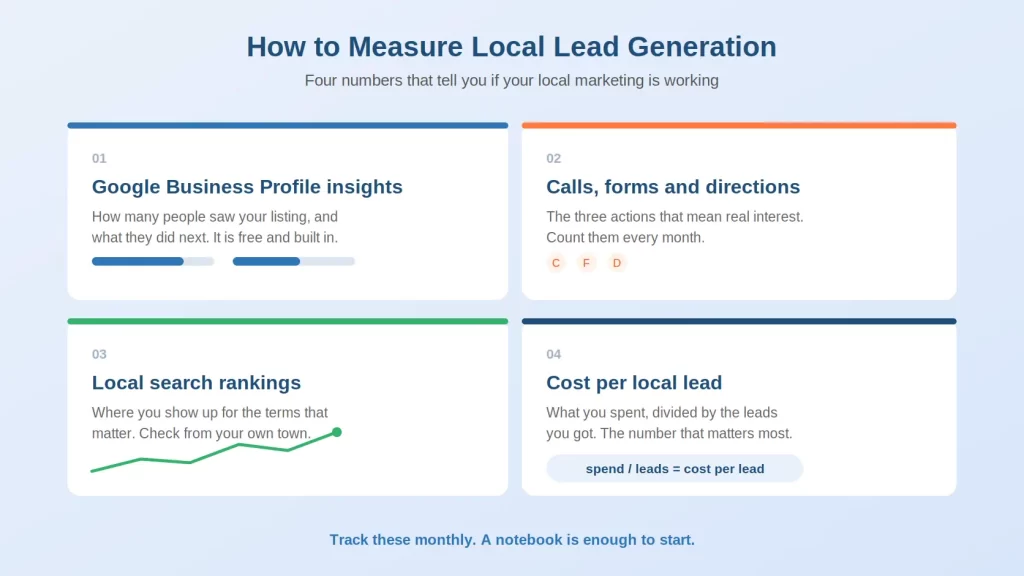
Google Business Profile insights
Your Google Business Profile gives you a free dashboard showing exactly how people find and act on your listing. It is the first place to look each month.
Check three numbers. How many people called you directly from the listing? Track the number who asked for directions. Note how many clicked through to your website. When these climb month over month, your local lead generation efforts are working. When they stall, it is a signal to refresh your profile, add photos, or step up your reviews.
Calls, forms, and direction requests
Beyond the profile, track every way a lead reaches you. Simply count phone calls, form submissions, and walk-ins. Note where each one came from by simply asking new customers how they found you.
This habit takes seconds and tells you which lead generation methods actually pay off. You might find that reviews bring your best customers while a paid channel brings tyre-kickers. That knowledge lets you double down on what works and quietly drop what does not.
Local search rankings for your key terms
Track where you appear when someone searches your main service plus your town. Watching your local search rankings over time can help you determine if your local SEO efforts are having a positive impact.
You don’t need any fancy tools to get started. Search your key terms yourself every few weeks, or use a free rank checker. Rankings alone do not pay the bills, but rising local search results are an early sign that more leads are on the way, often before the calls fully catch up.
Cost per local lead
If you run any paid ads, work out your cost per lead. Divide what you spent in a month by the number of genuine leads it brought. Compare that to what a customer is worth to you.
Every lead costs money, so it is important to know if it is worth the cost. For example, if you earn $500 from one job and a lead costs $30, you are still making a good profit. Compare the cost of leads from each marketing channel. Some channels will bring better leads than others. Spend more money on the channels that work best. This will help you get more local leads and grow your business.
Frequently Asked Questions
What is the fastest way to get local leads?
By far, paid local ads are the fastest. Google Ads targeted to your area can bring you calls within days if you’re using them correctly. Meaning, you have to send people to a specific landing page, not your homepage. But the cheapest and most reliable way to get local leads is your Google Business Profile. All you have to do is claim and optimise your listing and start getting reviews, which will bring you leads for free within weeks.
How is local lead generation different from regular SEO?
Regular SEO tries to rank a website for searches anywhere. Local SEO is about users searching in a specific area. This is the additional signal Google uses for local results. It includes your Google Business Profile, reviews, and map appearance. Local lead generation focuses on turning that local visibility into actual enquiries. SEO is one part of it. Reviews, ads, forms, and follow-up are the rest.
Do I need a website for local lead generation?
Not at the very start. A complete Google Business Profile can bring in calls and direction requests on its own, which is enough for some local companies to get going. However, a simple site can help you significantly by providing local landing pages, a place to collect reviews, and a lead generation form. It’s an investment that will pay off many times over if you plan on seriously generating leads for your business in the long run.
How many reviews do I need before they start helping?
There is no magic number, but it’s better to have a few recent reviews rather than a large number of old ones. You should strive to get as many reviews as possible and respond to each one. Having fresh reviews shows Google and your customers that your business is active. Which positively impacts both your SEO and conversion rates.
Can a small local business compete with bigger companies in search?
Small businesses can compete with big companies. In many cases, they can even do better. Big companies are not always the best choice in every town. A local business with a good Google Business Profile and positive reviews can rank higher in search results. Local SEO also helps more people find your business. Many customers like to support businesses they know and trust. They often choose a local business over a big company they have never heard of. This gives small businesses a real advantage.
Final Thoughts: Local Lead Generation Is a Long Game Worth Playing
Local lead generation is not a one-time push. It is a set of habits that, when practiced consistently, turns your business into the obvious choice for people searching nearby. The businesses that win locally are rarely the biggest. They are the most consistent.
Start with the basics. Claim and complete your Google Business Profile. Make sure your business name, address, and phone number are the same everywhere online. Add your city or local area to your website so people know where you work. Ask happy customers to leave reviews regularly. Create a few local pages for the areas you serve. If you need more leads quickly, use paid ads with a small budget.
Don’t try to do it all at once. Pick two tactics, execute them well, and evaluate their impact after 90 days of steady effort. Effective local lead generation is a long game that requires patience and persistence. The compounding is real. Six months of steady effort beat a frantic week every time.
Your business may serve more than one local area. It is important to understand the bigger market as well. We cover the full mix of online and offline tactics for smaller businesses in a companion guide. And it pairs naturally with everything here. Read both guides to get the full picture. They will help you get more local leads and grow your business.
People near you are already looking for your services. Make sure they can find your business. Follow our guide to picking the right first step, stay consistent, and you will get more local customers.
References
[1] Understanding Consumers’ Local Search Behavior. Google/Ipsos research, reported by BizIQ Local Search Statistics 2026. Original finding: 76% of people who search for something nearby on a smartphone visit a related business within 24 hours. https://biziq.com/blog/local-seo-statistics/ (Accessed June 2026)
[2] Understanding Consumers’ Local Search Behavior. Google/Ipsos research. Original finding: 88% of consumers who conduct a local search on a smartphone call or visit a business within 24 hours. https://www.thinkwithgoogle.com/consumer-insights/consumer-trends/how-advertisers-can-extend-their-relevance-with-search/ (Accessed June 2026)
