

To generate leads for a local business, you don’t need the biggest budget or the fanciest offer. The businesses that get the best results keep showing up. They update their Google Business Profile, ask happy customers for reviews, follow up with leads, and check what is working. Small actions, done regularly, work better than big actions done once in a while. This guide shows you exactly how to generate leads for a local business, step by step.
Here is why it matters. Nearly half of all Google searches, around 46%, are people looking for something local [1]. These are potential customers in your area, searching right now for the service you offer. The only question is: Will they find your business or someone else’s?
The good news is that you can start generating leads for your local business today. You don’t need to spend a lot, and you don’t need a marketing degree. The majority of the tactics that I’m about to share with you are free. They primarily involve utilizing tools that you already possess but may not be fully leveraging at present. I run Google ads for several local businesses. The same is true for almost everyone: paid ads bring in leads. While their free tools sit ignored, leaving easy local customers on the table.
These 7 powerful steps will assist you in correcting the issue. As long as you complete all of these steps, you will begin to see an increase in local leads coming your way rather than waiting for them to come to you.
How to Generate Leads for a Local Business: What It Really Means
Before the steps, let us be clear on what a lead actually is. A lead is a potential customer interested in buying your product or service. Plus, they are ready to provide their contact information by phone, online, or in response to your marketing efforts. That is it.
This matters because many local business owners chase the wrong thing. They count followers, likes, or website visits and think that is progress. It is not. One thousand people saw your post, but only one person called and set up an appointment; that’s a lead. The process of generating leads focuses on finding and influencing these would-be customers.

A lead is not the same as a customer
If you can attract visitors to your site but cannot convert them into customers. You need to work on the lead generation process. It has multiple steps, and a successful conversion happens only when all steps are properly executed. That is why the guide below walks you through each stage of the process. Getting the lead is step one. Following up and turning leads into customers is also important. We shall discuss them one by one.
Why local business leads are easier to generate than you think
Here is the encouraging part. Local lead generation is often easier than competing online with the whole world. Your competition is not every business on the internet. It is one of a handful of similar businesses in your area.
Many of them are not putting in the effort. Their listings are outdated, they do not seek reviews, and they do not engage in social media. That gap is your opening. When you do the simple things well, you stand out fast. Those potential customers become new leads for your business instead of theirs.
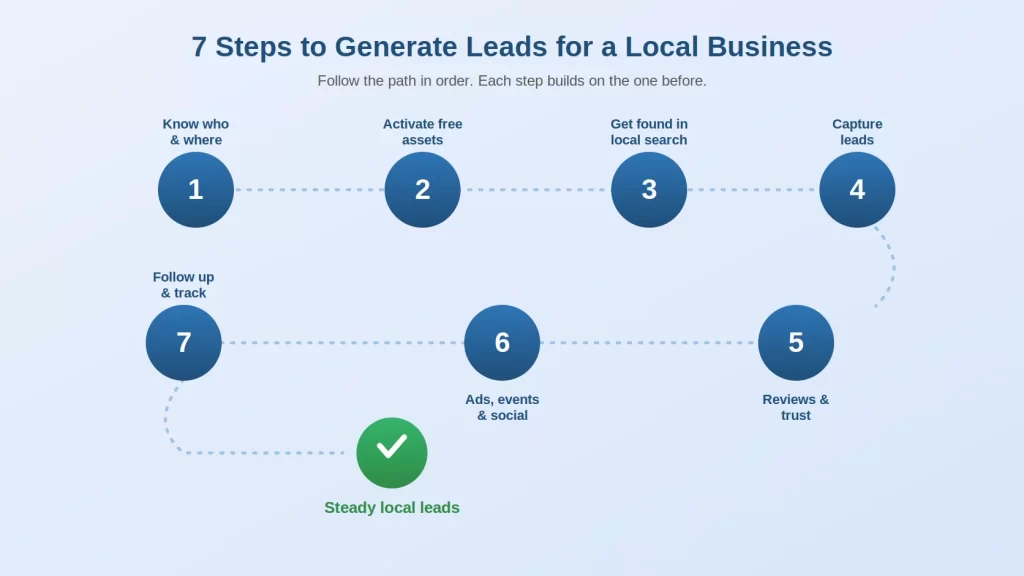
Step 1 — Get Clear on Who You Want and Where
The first step is easy, free, and will save you thousands of dollars in the long run. Narrow your focus to a particular category or segment before attempting to generate any leads.
Going after everybody is the beginner’s mistake; when you do so, you end up connecting to nobody. A more focused campaign will yield better results, even if it seems counterintuitive.
Decide who your best local customer is
Think about the customers that you want to attract the most. Consider the individuals who are the best fit for what you are trying to sell.
Be specific. What are they buying? What are they looking for? A cellphone repair service may be targeting individuals with broken screens who want to get them fixed the same day at a local repair shop. You may have a much better idea of who your ideal customer is at your local business than you think. The more specific you can be about your ideal customer. The more successful you will be at understanding them and attracting them to your business.
Define your local area
Local intent is the whole point here. Your customers are not across the country. They are down the road. So decide how far you realistically serve.
Is it one town? A few neighbouring suburbs? A radius of ten miles around your shop? This local area becomes the backbone of everything that follows. Starting from the words you use on your website to where you focus your ads. When you match your message to local consumers searching with local intent. Your leads get warmer, and your costs drop.
Match your service to what they actually search for
Once you know who you want and where, think about how they search. Real people do not search the way businesses describe themselves. They type plain things like emergency plumber near me or cheap phone screen repair.
Create a shortlist of the exact terms that your local audience uses to find local services. Keep each phrase simple. You will need this list again multiple times while completing the following tasks. It’s worth spending a couple of minutes going over this step carefully.

Step 2 — Activate the Free Assets You Already Have
This is the step most local businesses skip, and it is the one I see wasting the easiest leads. Before you spend a penny on ads, switch on the free tools you almost certainly already own.
Here is what I mean. I run Google ads for some local businesses in different industries. Almost all of them have a Google business profile and a Facebook page. They are listed on sites like Yelp, but almost none of them make use of any of these platforms actively. The profiles are half-filled in, the last post was a year ago, and the services are not shown anywhere. The paid ads bring leads in the front door while the free tools gather dust. That is money left on the table.
You can get there in an afternoon. Activate what you already have and start generating leads the fastest, easiest, and cheapest way possible.
Claim and complete your Google Business Profile
Your Google Business Profile (previously known as Google My Business) is your single most important free tool for any local business. It’s the listing that appears in Google Maps and local searches when someone looks for what you offer in your area.
Claim it if you have not already. Then complete every part. Add your hours, your services, your photos, and the right category. Make sure your business information is accurate and up-to-date. A complete listing helps make your business easy to find and acts as a signal to Google that your business is active and authentic, boosting your search rankings.
Get listed in local directories with consistent information
In addition to Google, be sure to list your business in other relevant directories, such as Yelp and your local chamber of commerce. Also, get listed on any industry-specific sites for your type of business.
Most importantly, keep your information consistent across all listings. Your name, address, and phone number should be exactly the same at every site. This avoids confusing search engines and customers and improves your chances of appearing in local searches.
Showcase your services on social media
This is the second part of the dormant asset conundrum, and it is no less prevalent than the first. The companies I work with have social media accounts that essentially serve as decorative devices, as they do not engage in active showcasing of their work
You see, you don’t have to sacrifice your time every day to daily posting and virality. Merely post the stuff you do. A picture of the completed project, a before-and-after snap, a tutorial, a testimonial with permission. It is all valuable content that promotes your brand and allows you to maintain visibility between search queries. After all, what is better than cultivating the image and reputation of a reliable contractor, a professional service provider? Then, you would achieve people’s trust to deliver on every given task?
Step 3 — Make Sure People Can Find You in Local Search
You have acquired several free SEO tools. Now it’s time to ensure that your website appears in the search results by using them. Local SEO is one of these tools, and it aims to optimise your website. Thus, you would appear on Google MAPS when your potential customers are searching for someone like you.
Local SEO might sound technical, but the basics are quite simple, and you can start with just a few things right away. You don’t have to be an SEO expert to do local SEO correctly. Just follow a few simple steps to appear in the local search results and beat your competitors who have no idea about local SEO.
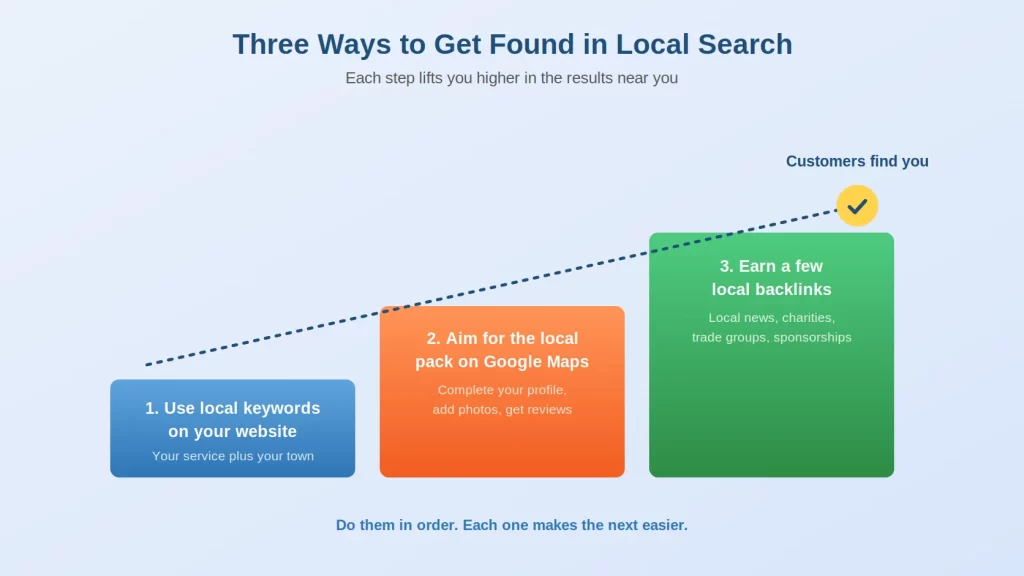
Use local keywords on your website
Recall the list of search phrases you compiled at step one. That’s where they earn their keep. Weave those local keywords into your website content, on both your homepage and your service pages. So that Google can easily find and index your page.
Be sure to identify your city and service area when using subheadings and in the body text of your page. A page describing the services of an emergency electrician in Dayton, Ohio, ranks better than a similar page that neglects to mention Dayton, Ohio. Avoid keyword stuffing, which detracts from the overall appeal of your web content. Write naturally, and your SEO-friendly copy will climb the search rankings.
Aim for the local pack on Google Maps
When searching for a specific service, Google provides a local pack of 3 businesses on the map. This box is one of the most valuable positions in the entire search engine. It offers a great opportunity to target clients looking for the services you provide.
To appear in the Google local pack, it is essential to optimise the business profile and gather customer reviews. Have an updated profile with feedback from clients. Then, you will provide Google with relevant information to appear in local packs for specific searches.
Earn a few local backlinks
A backlink is a link from another site to yours. To Google, each one is a vote of confidence. Backlinks from respected local sites are especially powerful for your search rankings.
You do not need hundreds. Get listed in your chamber of commerce. Sponsor a local team or cause and request a link. Partner with another local business that serves the same customer base but doesn’t directly compete. A few quality local backlinks can greatly boost your local search presence. They are much harder to come by for lazy competitors. That covers the setup. Here is how to generate leads for a local business once people can find you.
Step 4 — Build a Simple Page That Captures Leads
Getting found is great, but what are you going to do when they get there? Have an easy way for them to jump from the search results to your site and become a lead.. A surprising number of local businesses send all their traffic to a homepage that gives people nowhere obvious to go. That is a leak, and it costs you leads every day.
The fix is a focused page built to capture leads, not just to look nice.
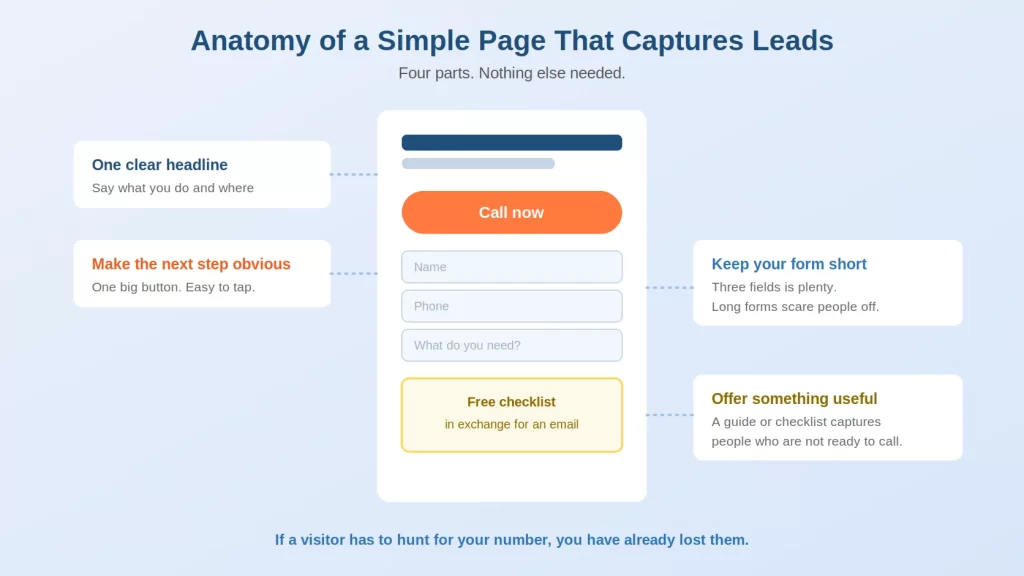
Make the next step obvious
When potential customers are ready to act, don’t make them work for it. Place your phone number prominently on the page (ideally at the top), where it can be seen and dialed immediately by cell phone users. Similarly, make sure there’s a short contact form readily available so that impatient prospects aren’t tempted to go elsewhere.
Use a strong CTA (Call to Action) button. Buttons such as Get a Free Quote and Book a Repair are much more effective than a generic Contact Us. Make it easy for prospects to take action. You are dramatically increasing your chances of converting website traffic into sales leads. This is one of the simplest and least expensive ways to boost your lead generation.
Keep your contact form short
Every additional field on a form will lose you some potential customers. Ask only for the bare minimum you need to contact them and describe the job in one line.
You can always ask for more information if they respond. A short form lowers the barrier and brings in more leads. A long, nosy form scares people off and leaves you with fewer. Short wins almost every time.
Offer something useful to capture more leads
If you want to get leads that are interested but not yet ready to buy. You can offer something useful as an incentive to download or subscribe to your contact list. This is called a lead magnet.
It does not need to be fancy. A simple price list or a short guide, or even a quote request, will be a great incentive to get someone’s email or phone number. After they’ve downloaded what you’ve offered, you can use drip marketing to help you nurture them back to your business eventually. A lead magnet is a great way to build a list of high-quality leads who have an interest in your business, and that list can help you get leads automatically.
Step 5 — Ask for Reviews and Show People You Can Be Trusted
Before anyone contacts a local business, they ask themselves one quiet question: Can I trust these people? Your job is to answer yes before they even reach out. Reviews and trust signals do exactly that, and they turn cautious browsers into confident leads.
This step is one of the most important steps which is largely overlooked. Local businesses know that reviews matter. However, few of them request reviews on an ongoing basis.
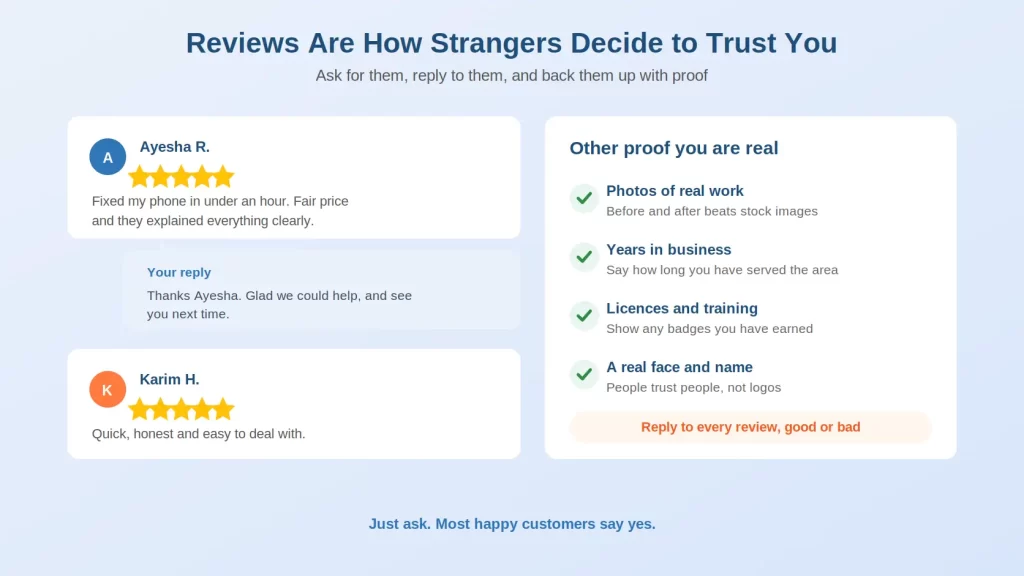
Ask every happy customer for a review
Reviews are the closest thing to having your customers sell for you. People believe other customers far more than they believe any advert. In fact, 75% of consumers say they always or regularly read online reviews when researching a local business [2].
So ask. Request reviews after each completed service is done, so long as the client is satisfied with the results. You can do this by asking customers to leave a review with a direct link on the spot. Do this every single time and a steady stream of fresh reviews builds up. Each request will help you get your business recommended to the next potential customer who is browsing your profile.
Respond to every review, good or bad
Replying to reviews matters almost as much as getting them. A friendly reply to a good review shows you care. A calm, helpful reply to a bad one shows future customers how you handle problems.
Never ignore a negative review or argue. Apologise, offer to make it right, and move on to the next review. People who see your review after yours has posted will hold what you say against you more than they’ll hold the original complaint against you. Active, well-handled reviews build the kind of trust that attracts potential leads who are ready to act.
Show other proof that you are the real deal
Reviews are the most important signals of trust, but they’re not the only ones. Show people who read your review that you’re trustworthy. You can do that in several ways.
Display your licenses or certifications. Add before-and-after photos of actual jobs. Show a service-area map, how long you’ve been in business, or certifications from organisations you belong to. These small signals quietly remove doubt. These add credibility and reassure website visitors who are serious about making a purchase, which is why they lead to higher call volumes.
Step 6 — Reach More People with Ads, Events, and Social Content
The first five steps build a strong foundation that brings in leads for free over time. This step is about speeding things up and reaching people you would otherwise miss. Once your basics are solid, a little paid and proactive effort goes a long way.
You do not need a big budget. You need to spend a small one wisely, in the places your local customers already are.
Start small with targeted local ads
When time is of the essence and you need leads now rather than later, paid advertising is the fastest way to get them. With Google Ads, you can appear at the top of the search results the moment somebody looks for a service like yours in your area. The key word is targeted. You are not advertising to the world, just to your local area.
Start small. Just spend ten or twenty dollars a day on one service in one location and see how it does. Keep your ads local and make sure they direct visitors to the landing page you created in step #4, not your homepage. Watch your cost per lead and adjust. Done well, targeted local ads bring in leads within days, which is why they are a useful part of any local digital marketing plan.
Show up at local events
Not every lead comes from a screen. Real-world presence still works, especially for a local business that runs on trust. When someone becomes engaged in their local community, they tend to remember your name.
Put up a booth at the community center, sponsor a local youth sports team, or get involved in the local chamber of commerce. These events will put a face to your business name. Referrals from the community can sometimes be more valuable than those found online. Partnering with local influencers who already have a following in your area can allow you to quickly reach a large local audience.
Share content that’s of interest to the local community
This is where you finally use your social media properly, the gap we talked about in step two. The trick is to post content addressing local interests, not generic sales posts.
Share a project you completed in a named neighbourhood. Mention a local event you took part in. Answer a common question people in your area ask. Content tied to local interests gets seen and shared by the exact people you want as customers. It keeps you visible between searches and slowly builds you into the business locals think of first.
Step 7 — Follow Up Fast and Track What Works
You have done the hard part. Leads are coming in. Now comes the step that decides whether they turn into paying customers or quietly disappear. Following up fast is where most of the work of generating leads for a local business is won or lost.
This is where many local businesses fall down. They put real effort into getting leads, then let them go cold. A lead ignored for a day is often a lead lost to a competitor.

Respond as fast as you can
Speed is everything with a fresh lead. Research from MIT found that businesses that contact a new lead within five minutes. They are far more likely to qualify that lead than those who wait even thirty minutes [3]. After an hour, most of them will forget.
Just make sure you don’t forget. To stay on top of this, schedule alerts so you don’t miss a single message. Reply to each one, no matter how short your response is. Even a simple “I’ve called you back, but you didn’t answer; I’m calling again in an hour” reassures the client that they are in good hands. It will keep you a step ahead of competitors who have yet to wake up.
Nurture the leads who are not ready yet
The truth is, not everyone is ready to buy right this second. Some are comparing options or planning ahead. These are still worth real money if you stay in touch.
This is where you attract and nurture leads over time. A friendly follow-up message a few days later. A helpful email to the list you started with your lead magnet. A quick check-in that adds value rather than pressure. When you nurture leads patiently, many will come to you on their own when the time is right, having appreciated your support and guidance.
Track your leads so you know what works
Finally, keep things simple by maintaining a basic record of where your leads are coming from. You can’t improve what you don’t measure – but you don’t need to go all out with some fancy CRM either. Just a simple spreadsheet or even pen and paper will suffice.
For each lead, make a note of how they found you. Over a few weeks, clear patterns appear. Maybe your Google Business Profile brings the most calls, or referrals bring your best customers. When you track leads this way, you can see your real local lead generation results, put more effort into what works, and quietly drop what does not. That simple hack is how you can get more leads month in and out without spending a dollar.
Frequently Asked Questions
How do I generate leads for a local business with no budget?
Start with the free steps in this guide. Claim and complete your Google Business Profile, ask every happy customer for a review, and showcase your work on social media. These tactics are totally free. In most cases, they will be enough to generate a steady stream of leads for your local business before you invest any real money. Once that foundation is built, you can begin paid ads.
How long does it take to start getting leads?
It depends on the technique. If you use paid methods, then it is possible to get leads in just a couple of days. Regarding free methods, such as local SEO and reviews, they may take several weeks or even months to bring results. However, it is a good idea to use both strategies. You can invest some money in paid promotions to get leads right away, while you are waiting for the slow, steady growth of organic methods.
Do I need a website to generate leads?
Not at the very start. A complete Google Business Profile can bring in calls and messages on its own. But you need a simple website to collect your leads and reviews. It will help you even to appear in the first place. Which is why, if you plan on doing online lead generation seriously, you should invest in a simple, inexpensive website.
What is the best way to generate leads for a local business?
There is no magic bullet, but if you must pick one, it is your Google Business Profile combined with steady reviews. For most local businesses, this is the most effective of all the strategies here. Because it puts you in front of people at the exact moment they are searching and ready to act.
How is this different from small business lead generation in general?
A lot overlaps, but local lead generation is tighter and more geographic. General small business lead generation might target customers anywhere. Here, every step focuses on your local area, from local keywords to local reviews to local ads. The narrower the target is, the better this strategy will be for the business of local service.
Final Thoughts: How to Generate Leads for a Local Business, Consistently
Attracting prospects to your local business is not something mysterious. It is a particular set of consecutive steps that requires patience and integrity. Those who have succeeded in this area understand that being the best is not about being shiny but rather about being consistent.
That said, better not to rush and overwhelm yourself with tons of recommendations at once. There is a high chance that you will quit in a while. You should take the first step by making good use of all the free resources. At the start, optimise the Google Business Profile and ask for reviews. Only then can you look around and realise that you have more than half of the competition behind you. Why? Because the vast majority believe that neglecting these minor details will not make any difference.
Take the first steps, then build up
First, you learn with free lead tools. Then, you take the next step to grow bigger. Which is to start creating the landing page for local lead generation. Run a local ad, promote your appearance at the community event, and so on. When you take some of these actions that will form a constant stream of local leads. It would replace the occasional phone calls that come your way.
The thing about local leads is that most local businesses already have a good amount of them. Yet they don’t actively pursue them. Your listing is incomplete; online reviews are not requested. And your social media presence is underutilised. Simply rectify the obvious mistakes and follow a few additional guidelines. And you’ll be one step ahead of the local market competition. It would provide a solid foundation for both monthly recurring customers and continuous leads for sales.
Guides to take your lead generation further
If you’d like to get a more global perspective on finding customers for your small business. Please do check out the two other guides I have written on the topic. The guide to small business lead generation walks through all the strategies. You can use them to find nearby customers. They cover both digital and traditional methods. For a deeper look at the reasoning behind these tactics, take a look at my other guide to local lead generation. That’s the simple way to get local customers. Keep moving forward, and you can do this!
References
All factual claims in this article are supported by the sources listed below. Claims verified as of June 2026.
[1] Local SEO Statistics 2026. Backlinko, citing Search Engine Roundtable. Original finding: 46% of Google searches have local intent. https://backlinko.com/local-seo-stats (Accessed June 2026)
[2] Local Consumer Review Survey 2026. BrightLocal. Finding: 75% of consumers always or regularly read online reviews when researching local businesses. https://www.brightlocal.com/research/local-consumer-review-survey/ (Accessed June 2026)
[3] Lead Response Time: Every Study (Harvard, MIT, More). AInora, April 2026. Original research: MIT Lead Response Management Study by Dr James Oldroyd. https://ainora.lt/blog/lead-response-time-statistics-every-study-2026 (April 2026)
