
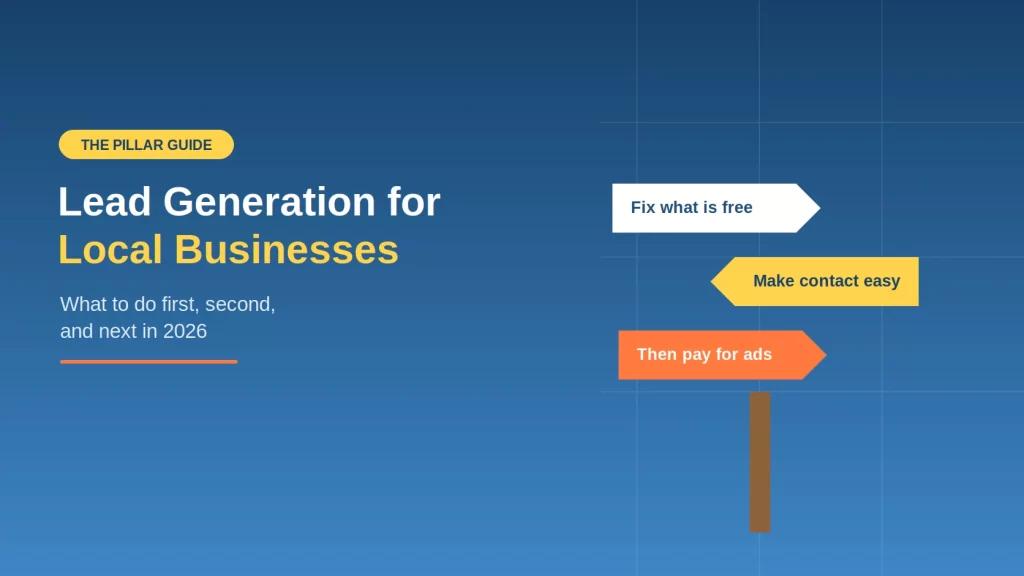
Lead generation for local businesses means getting nearby people to contact you. They find you. They call or message. You turn them into customers. That is the whole job.
The hard part is not learning the lead generation strategies. There are dozens of them. The hard part is knowing which one to do first.
So this guide is about lead generation for local businesses, and where to start. It will not hand you another list of tips. It will help you choose. You will learn what to do first, what to do next, and what to skip for now. You will also learn what to spend, and when.
Most local business owners get the order wrong. They spend money before they fix the free things. Then they wonder where the money went. Let us make sure that is not you.
What Lead Generation for Local Businesses Really Means
A lead is someone interested in your business. They call you. They fill in a form. Or they send a message. They are not a customer yet. But they are close.
Lead generation is the process of getting more of those people to contact you.
For a local business, this work has one special feature. Your customers are nearby. You do not need the whole world to know you. You need your town to know you.
So your local customers are the only people who matter here. That makes the job smaller. It also makes it easier. You are not fighting big brands everywhere. You are trying to win a few streets.
And there is plenty to win. Nearly half of all Google searches are local.¹ People look for help close to home, right now. Your job is to show up when people are looking.
There are many ways to do this. Some are free. Some cost money. A few work fast. Some take months but then last for years. So, this guide will help you choose.
Why Lead Generation for Local Businesses Often Starts in the Wrong Place
I see this happen all the time. It costs owners real money.
A business owner comes to me. They want to run ads. The budget is ready. They want to start today.
Then I look at their free listings. The Google profile is half empty. No photos. Wrong hours. No new reviews in two years. Their social pages have not been touched since the day they opened.
So they are ready to spend dollars for attention. But they are not ready to receive it.
What happens when you skip the basics
Think about what an ad really does. It sends a person to look at you. That is all it does. In short, it buys a look.
Now imagine that person looks and sees an empty profile. No photos. Two old reviews. A complaint nobody answered.
So, they leave. You paid for that look, and you got nothing back.
This is why order matters so much. Google Ads do not fix a weak online presence. They just show more people the weak parts.
Free first, then paid
The fix is simple. Fix the free things first. Then pay to connect more people to check out your products or services.
Free work is boring. It takes a few hours. It does not feel exciting. But it is the cheapest lead generation you will ever do.
I am not against ads. Running them is my job. I am against running them too early.
Three Questions to Ask Before You Spend on Lead Generation
Before you pick a tactic, answer these three questions. They take five minutes. They can save you months.
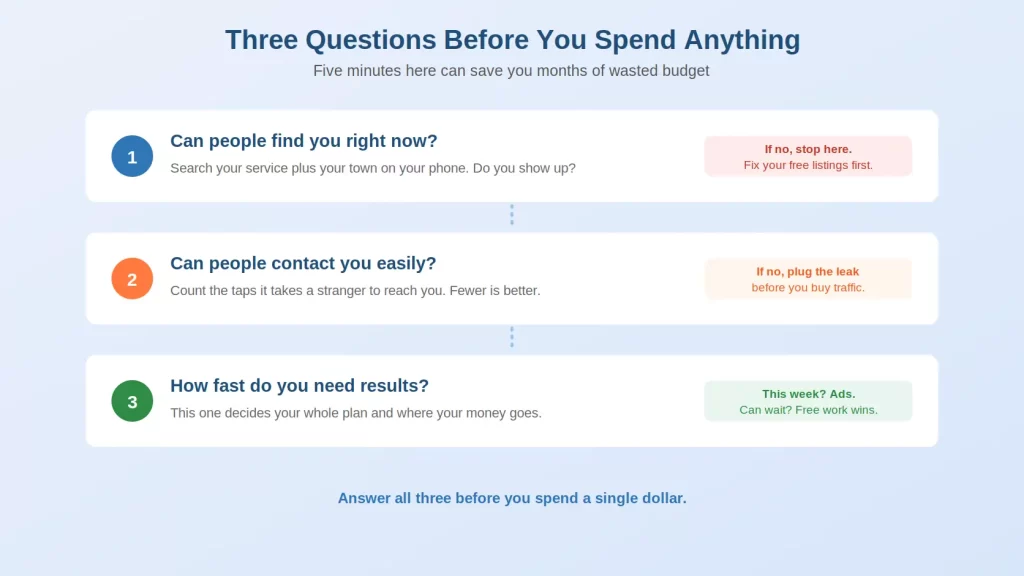
Question 1: Can people find you right now?
Search for your own business on your phone. Use your service and your town. Something like “phone repair in your town name”.
Do you show up? Is your listing complete? Does it have photos and recent reviews?
If the answer is no, you have found your first job. It is free. So, do it before anything else.
Question 2: Can people contact you easily?
Now look at your listing and your website the way a stranger would. How many taps does it take to reach you?
Is your phone number easy to see? Does the form work? Does anyone answer the messages?
Many businesses pay to get leads but lose them at the last step. You’re losing leads. Fix that first.
Question 3: How fast do you need results?
This one decides your whole plan.
Paid ads can bring in leads much faster. Nothing else is that fast.
If you’re not in a hurry, SEO gives better results for your money. It builds, and it keeps working after you stop.
Most businesses need both in the end. The order just changes based on your answer here.
Free, Cheap, and Paid Ways to Generate Leads
Every way to generate leads trades three things. Speed. Cost. And how long it lasts.
Nothing gives you all three. So pick based on what you need right now.

Organic lead generation: slow, but it keeps giving
This is your Google profile, your reviews, your local directories, and your website.
This work is often called local SEO. It costs time, not money. Thus, it is slow. You may wait three to six months for real results.
But it builds on itself. Work you do this month still brings leads next year. And people trust these results more than ads.
The prize is big too. The top three map results take about 42 out of every 100 clicks on a local search.² Businesses in that box get roughly 126 percent more traffic than the ones ranked just below it.³ That is a lot of local leads to gain from free work. Good visibility in local search results keeps paying you back.
Google Ads: fast, but rented
Google Ads are the opposite. You can run a live ad today. Leads can arrive within hours.
Paid ads only work while you’re paying for them. You are renting attention. You are not owning it.
So paid ads are best for three jobs. Filling a slow week. Testing what people want. And growing once the free work is already done.
Word of mouth: free, but hard to control
Referrals are the highest-quality leads you will ever get. They arrive warm. The sale closes fast. They cost nothing.
But you cannot switch them on. You can only earn them by doing good work and then asking.
So ask every happy customer for a review and a referral. You can also meet people through local events and local business associations. It costs nothing. And it works quietly, for years.
Which Local Lead Generation Approach Fits Your Business?
There is no single right answer. It depends on what kind of business you run. Here are the common cases.
If you are brand new
Start with free work only. Your profile, your listings, your first reviews.
You have no proof yet, so ads will not convert well. Build a little proof first. Then pay to spread it.
If you have been around for years
You may already have reviews and regulars. Your problem is often visibility, not trust.
So check your listings first, then move to ads sooner. You have something worth showing.
If you sell an urgent local service
Think plumbers, locksmiths, and repair shops. People search when something breaks. They call the first good option.
Speed matters most for you. Be in the map results. Answer fast. Ads work well here because the need is immediate.
If you sell something people plan for
Think weddings, training, or home renovation. People research for weeks before they choose.
So your job is to show up early and look trustworthy. Reviews, photos, and helpful pages matter more than speed here.
If you serve more than one area
Make a page for each area you serve. One page cannot rank well for three towns.
This is slow work. But it is how you win searches in every place you cover.
Your First 90 Days of Local Lead Generation, In Order
Here is the plan I would give a new client. It is in this order for a reason. Each step makes the next one work better.

Days 1 to 14: Set up Google My Business and fix your listings
Claim and complete your Google Business Profile. Add real photos. Set the correct hours. Pick the right category.
Make sure your business information stays the same everywhere online. Consistent business information helps Google trust you.
Then ask your last ten happy customers for a review. Just ask them. In fact, most say yes.
This costs nothing. For many businesses, this step alone brings the phone back to life.
Days 15 to 30: make it easy to contact you
Put your phone number where a thumb can reach it. Top of the page. Every page.
Add one simple form to capture leads. Name, phone, and what they need. Nothing more, because long forms scare people away.
Then agree on one rule with your team. Every new lead gets a reply fast. Speed wins jobs more often than price does.
Days 31 to 60: build a little proof
Add a page for each service you sell. Then add a page for each area you serve. Each page can target its own local keywords.
Write one short, useful post for your local audience about a real job you did. Show a photo of the work.
And keep asking for reviews. Aim for a steady trickle, not one big burst.
Days 61 to 90: now you can pay
Only now do you turn on paid ads. Your profile looks alive. The reviews are fresh. Your phone gets answered.
Start small. Then watch what happens. The ad money now lands on solid ground.
Do it in this order and paid traffic converts far better. Do it backwards, and you pay to show people an empty shop.
How Much to Spend on Lead Generation for Local Businesses, and When
This is the question every owner asks. So here is an honest answer, stage by stage.
Stage 1: spend nothing
If your free listings are not fixed, spend zero on ads. Not one dollar.
I know that is not what people want to hear. But money spent here is money wasted.
Your only cost at this stage is a few hours of your own time.
Stage 2: start small
Once the basics are solid, begin with a small daily amount. Enough to gather data. Not enough to hurt if it fails.
Then run it for at least two to four weeks. One week tells you nothing. Ads need time to settle.
Watch two numbers. How many leads came in. And what each one cost you.
Stage 3: Do more of what works.
The businesses I run campaigns for spend around fifty to sixty dollars a day once they reach this stage. That is roughly fifteen hundred to eighteen hundred dollars a month.
That is not a magic number. It is simply what works for their local market and the number of jobs they can handle.
The right number for you depends on three things. What one customer is worth to you. How many jobs you can take. And what your competitors are paying.
So only scale when the numbers work. If ten leads cost you a hundred dollars, and two of them become customers worth five hundred each, keep going. If not, fix the leak before you spend more.
Know What a Customer Is Worth Before You Spend
Here is a number most owners have never worked out. And without it, every spending choice is a guess.
What is one customer actually worth to you?

Work out the simple version
Take what an average customer pays you once. Then think about how often they come back in a year.
A phone repair shop might earn forty dollars per visit, and see that person twice a year. So that customer is worth about eighty dollars a year.
A wedding photographer might earn one thousand dollars once, and never see them again. But that one customer may send two friends.
You do not need to be exact. A rough number is enough. It just has to be honest.
Now you can judge any price
Once you know that number, everything gets easier.
If a customer is worth eighty dollars, you cannot pay sixty dollars for a lead. Not unless nearly every lead becomes a customer.
But if a customer is worth one thousand dollars, then paying sixty dollars for a lead is a bargain.
So the same lead price can be great for one business and terrible for another. That is why copying another business’s plan rarely works.
Do not forget repeat work
Many owners only count the first sale. That makes every lead look too expensive.
Count the repeat business too. And count the friends they send you.
A customer who returns four times a year is worth four times as much. Once you see that, you will spend with far more confidence.
The Honest Truth About Guaranteed Returns
Clients ask me this often. Can you guarantee I will make ten times what I spend?
I understand why they ask. It sounds like a fair test. But here is the honest answer.
Nobody can guarantee a return on ad spend. Not me. Not any agency. Anyone who promises it is either guessing or lying to you.

Why nobody can promise it
Too many parts sit outside anyone’s control.
Your competitors can raise their bids tomorrow. Google can change how the results look. A slow season can arrive. Someone on your team can miss five calls on a busy afternoon.
Ads can bring you the lead. They cannot answer your phone. They cannot close the sale for you.
What you can expect instead
A good marketer can promise effort, clear reporting, and honesty. They can promise to track every lead and tell you what each one cost.
They can promise to stop spending when something is not working, instead of quietly letting it run.
That is worth far more than a promise nobody can keep. So if someone guarantees you ten times your money, walk away. It is the clearest warning sign in this industry.
How to Tell If Your Lead Generation Is Working
Most local businesses fly blind. They spend, they hope, and they never check.
You do not need lead generation software. You need one habit.
Ask every caller how they found you
Then write it down. A notebook is fine. A simple sheet is better.
After a month, you will see a pattern. Some sources bring many calls. Some bring none at all.
That single habit beats most reports.
Watch cost per lead, not clicks
Clicks feel good. But clicks do not pay bills.
So divide what you spent by how many leads you got. That is your cost per lead. It is the number that matters.
Then go one step further. How many of those leads became customers? A cheap lead that never buys is not cheap at all.
Give each channel a fair trial
Do not judge free search work after two weeks. It needs months.
And do not judge ads after two days. They need weeks.
So set a review date when you start. Then wait for it before you decide anything.
When to Change Course, and When to Wait
Knowing when to stop is as useful as knowing when to start. Here is how to tell the difference.
Signs you should wait
The channel is new and has not had a fair trial yet. Leads are arriving but you are slow to reply. The numbers are moving up, just slowly.
In all these cases the problem is patience or process. It is not the channel.
Signs you should change
You gave it a fair run and the leads are not there. Or leads arrive but few of them are qualified leads. Or one customer costs more to win than they are worth.
Then change something. But change one thing at a time. If you change everything at once, you learn nothing.
The mistake most owners make
They quit the slow work too early. And they stick with the fast work too long.
Free search work feels like nothing is happening for months. Then it works, quietly, for years.
Ads feel great from day one. But they can bleed money for months if nobody checks the numbers.
So be patient with the slow. And be strict with the fast.
Local Lead Generation Mistakes That Quietly Waste Money
These are the ones I see most often.
Paying for ads before fixing free listings. We covered this above. It is the most expensive mistake on this list.
Chasing every new channel. A new app appears, and everyone rushes to it. Meanwhile their Google profile still has no photos. Do the boring thing well first.
Never asking for reviews. Reviews affect both your ranking and your trust. Yet most owners simply never ask.
Replying slowly. A lead who waits an hour often books with someone else. And speed is free, and it wins jobs.
Judging by feel. It feels busy is not a number. Write things down instead.
Doing everything at once. Pick one thing. Then finish it. Thereafter, pick the next one.
Build a Simple Lead Generation Plan You Will Follow
A big plan that sits in a drawer is worth nothing. A small plan you follow every week is worth a lot.
So keep it tiny. Here is how.

Pick one job a week
Not five. Just one.
This week, add photos to your profile. Next week, ask five customers for a review. The week after, write one service page.
Small jobs get finished. Big plans get abandoned. That is just how it works.
Set one hour aside
Book one hour in your week for this work. Treat it like a customer appointment. Do not move it.
One focused hour a week beats a whole day once a year. Because this work rewards steady effort, not bursts.
Check your numbers once a month
Once a month, sit down with your notebook. How many leads came in? Where did they come from? What did each one cost?
Then pick your next job based on what you see. Not on what feels exciting.
Expect quiet months
Some months nothing seems to move. That is normal, especially early on.
Your local lead generation efforts take months to show. The businesses that win are not the clever ones. They are the ones still doing the work in month six, when the slow effort finally starts paying.
Frequently Asked Questions
How long before I see leads?
Ads can bring leads within days. Free search work usually takes three to six months. But fixing your profile and asking for reviews can bring calls within weeks. Real, steady results take about three months of consistent work.
Do I need a website?
Not on day one. A complete Google profile can bring leads by itself. But a simple website helps you show up for more searches and gives people a place to learn about you. So start with the profile, then add the site when you can.
What if I have no budget at all?
Then you are in luck, because the highest value work is free. Fix your profile. Ask for reviews. Keep your details the same everywhere. Reply fast. Most businesses never do these, so doing them puts you ahead.
Should I hire someone or do it myself?
Do the free basics yourself. They are simple, and you know your business best. Then consider help when you start spending real money on ads, or when the work takes more time than you have.
How do I know if my agency is doing a good job?
There are many lead generation companies and lead generation services out there. The best lead generation company for you is the one that answers this question. What did each lead cost last month? A good agency answers straight away. If they only show you clicks and impressions, be careful.
Your Next Step in Lead Generation for Local Businesses
Let us keep this simple.
Lead generation for local businesses is not about knowing every tactic. Effective lead generation is about doing the right things in the right order. Small business lead generation follows the same rule.
Fix what is free. Make it easy to contact you. Ask for reviews. Then, and only then, pay to bring in more people. That is how you generate leads for a local business without wasting money.
So start with one thing today. Search for your own business on your phone and look at what a customer sees. Whatever looks weak, fix that first.

From here, pick the guide that matches where you are. For the full mix of ways to find new customers, start there. To understand how to win more customers in your area, read the strategy guide. If you want a step-by-step setup you can follow today, follow the steps. And to see how local search decides who shows up, read the search guide.
Your next local customer is already searching. Go and be there.
References
- Search Engine Roundtable (2018) — reporting a Google representative’s statement at the Secrets of Local Search conference that 46% of searches have local intent. Widely cited industry benchmark; not published directly by Google.
- Backlinko — local SEO statistics, including the finding that 42% of local searchers click a result in the Google map pack.
- SOCi — local SEO statistics, including the finding that businesses in the local pack receive about 126% more traffic than those ranked 4 to 10.
- Whitespark — Local Search Ranking Factors, the industry survey of local ranking signals (2026 edition published November 2025).
