

Local SEO lead generation refers to the process of using local search. It helps to attract and capture the attention of nearby potential customers. You show up when they search. They click, call, or visit. That is the whole idea.
Here is why it is essential. Nearly half of all Google searches are local¹. People are looking for a service in their area. When these searches occur, a small group of businesses shows up first. Those businesses get the calls. The rest get missed.
This guide is different from a list of tips. It follows the path a customer takes when they search. You will see how local search visibility actually works. You will learn what makes Google pick one business over another. And you will learn how to be the one it picks.
Most of your local rivals do not understand this. They set up a website and hope. You are about to do better. Let us start where your customer starts: the search.
What Local SEO Lead Generation Really Means
Let us break the phrase down. It has two parts that work together.
Local SEO is how you help your business show up in local search results. When a nearby buyer looks for a thing you provide, good SEO helps you be one of the first results. Lead generation is what comes next. Those people contact you. They become leads.
Put them together, and you get local SEO and lead generation. It is the steady way to turn local searches into real customers.
Here is the key idea. SEO and lead generation are not two separate jobs. They are one path. These bring the right people to you. Then your job is to turn them into leads. Miss either half and the whole thing breaks.
Think about it as a shop located on a street. Local SEO makes your shop appear on a street where people walk by. Without it, your shop is on some distant street. And people will never find you, no matter how good you are.
This is why SEO leads are so valuable. These people are not random. They searched for exactly what you sell. They are close by. And they are often ready to act today. Thus, leads from SEO are more likely to become paying customers. They perform better than leads from other sources.
The rest of this guide shows you how it works, step by step. We follow your customer from their first search all the way to the moment they choose you.
How Google Decides Who Shows Up
When someone searches for a local business service, Google will feature a few business results at the very top of the search engine results page. It does not pick at random. It follows rules. Once you know these rules, you can work with them.
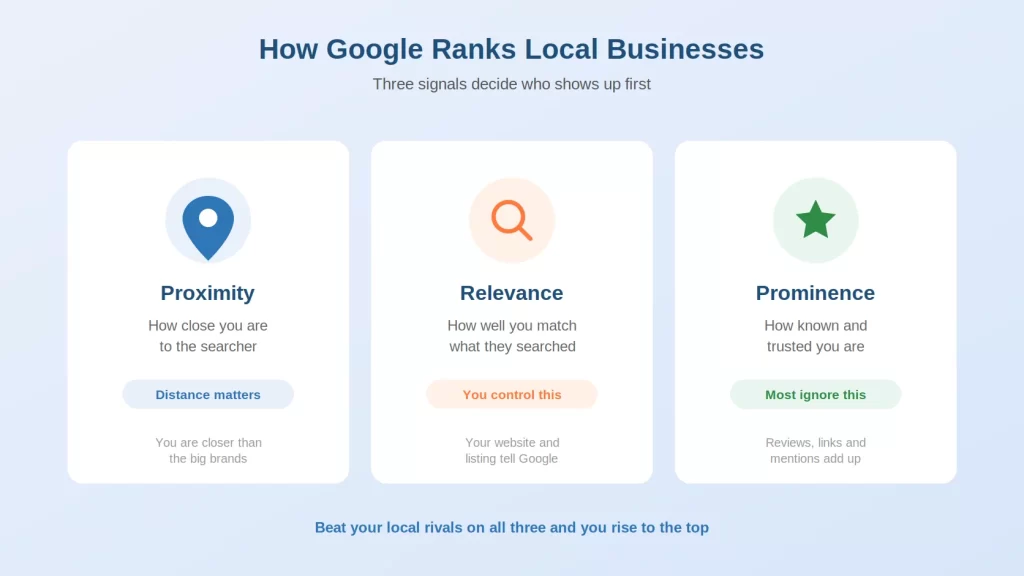
Google’s local traffic looks at three main things. These are commonly referred to as proximity, relevance, and prominence in the SEO world. These are key factors when it comes to local search rankings. Let us look at each one.
Proximity: how close you are
Proximity just means distance. How close is your business to the person searching? Google wants to show nearby options first. It makes sense. If someone searches for a plumber, they do not want one fifty miles away.
You cannot move your shop, so this one feels fixed. But it still helps to know it. It is why a small business can beat a big brand in its own town. You are closer. That counts.
Relevance: how well you match
Relevance means how well you fit the search. If someone types “emergency dentist near me”, they want a dentist right now because their tooth hurts. Google shows dentists who can help right away, not ones who only do braces or pretty smiles.
But This part you can control. So, you tell Google what you do through your website and your listing. The clearer you are, the better you match. We will cover exactly how in the next sections.
Prominence: how known and trusted you are
Prominence means how well known your business is. Google looks at your reviews, your links, and your mentions across the web. A business with many good reviews and a solid web presence looks more trustworthy. So Google ranks it higher.
This is the part most local businesses ignore. And that is good news for you. A little effort here goes a long way.
The local search ranking factors that matter most
These three things decide who wins visibility in local searches. They are the local traffic ranking factors that matter most. One well-known industry study found that your Google listing drives roughly a third of local ranking power. Your website adds about a fifth. Your reviews add more still.²
You do not need perfect scores. You just need to beat the other businesses in your area. Most of them are barely trying. Understand these rules, work on each one, and you move up the search results. Higher spots, more clicks, more leads.
Winning a Spot in the Local Pack
Perform a local search on your phone for a business in your area. For example, I could type in “coffee shops near me”. What shows up first? A small map, with three businesses listed under it. That box is called the local pack. Some people call it the map pack. This box is the best spot where your business appears. It shows the first group of results. Notice how this particular coffee shop has a map, star rating, opening hours, and a phone call button. Most people look here first.
The numbers back this up. About 42 out of every 100 clicks on local traffic go to the local pack.³ And businesses in the pack get 126 percent more visits than those ranked just below it.⁴ Being in that box changes everything.
Only three spots
Here is the catch. The local pack shows just three businesses. Everyone else is below the fold, where far fewer people look. So the goal is clear. You want one of those three spots.
That sounds hard. It is not as hard as you think. In most towns, only a couple of businesses are in it. Beat them, and the spot is yours.
Your Google Business Profile is the key
The local pack is determined by your profiles. This is your free claim. That has your name, phone number, address, hours of operation, photos, and reviews. Having a good profile is the most important thing. Because it helps your business to appear in the local pack.
You need to claim it and fill it out fully. We cover exactly how to set it up in our step-by-step guide to setting up your profile, so we will not repeat all of it here. For now, know this: a bare or empty profile will not make the pack. A complete, active one has a real shot.

What lifts you into the pack
A few things push your business profile up. Keep your details correct and complete. Add real photos. Get steady reviews. Pick the right business category. Post updates now and then.
None of this is hard. It just takes a little care that most local rivals skip. Do it well and your local visibility climbs. You show up in more local search results. And the local pack, with all those ready-to-act clicks, comes within reach.
On-Page SEO: Optimising Your Website for Local Search
Your Google profile gets you into the map pack. But your website matters too. It backs up your profile and helps you rank in the normal search results below the map. This work is called on-page SEO. It just means fixing the things on your own website.
The good news? These are small changes. You can make most of them yourself.
Use local keywords
A local keyword is a search phrase with a place in it. Think “plumber in Dhaka” or “bakery near Dhanmondi.” These are the exact words your customers type.
So use them on your site. Put your service and your town in your page titles. Add them in your headings. Also, place them in your text, where they read naturally. Do not stuff them in. Make sure to describe what you do clearly and where you do it.
Make a page for each service and place
If you offer multiple services, make sure there is a page for each. A plumber might have a page for fixing leaks and another for drain cleaning. Each page can target its own local keyword.
The same goes for areas. If you serve three towns, a page for each town helps you show up in all three. This is one of the most powerful moves in optimizing your website for local traffic. Most small businesses never do it.
Add helpful local content
Local content could be anything on your site that specifically targets your local audience. A brief post about a recent project you completed in the area. A simple guide that answers a common local question. A page about an area you serve.
This kind of SEO content does two things. It helps Google see that you are truly local. And it builds trust with the person reading it. You do not need to write a lot. One helpful piece now and then is plenty.

Keep it simple and clear
You do not need fancy tricks. Clear titles. A page for each service and place. A bit of honest local content. Do these, and your website starts to earn its own spots in the local traffic rankings.
Your profile and your website now work as a team. Next, we make sure the rest of the web agrees on who you are.
Local Citations and Local Business Listings
A citation is any online resource that features a company’s name, address, and phone number. You are aware of online directories such as Yelp, Yellow Pages, and other small business sites. These listing websites are considered citations.
Why do these matter for ranking? Google checks them to confirm you are real. Why do consistent details build trust? When many trusted sites list the same details, Google trusts you more. That trust helps lift you in local visibility.
Keep every listing the same
Here is the one rule that matters most. Your name, address, and phone must match everywhere. Exactly. “Street” on one site and “St.” on another can confuse Google. We explain why this consistency builds trust in our local lead generation guide, so treat this section as the ranking side of the same coin.
So pick one exact version of your details. Then use it on every listing, every time. This sounds small. It is not. Mismatched listings quietly hold back many good businesses.

Where to list your business
Start with the big ones. Your Google Business Profile, first, always. Once called Google My Business. It is a free listing. Then the well-known directories in your country. Then any trusted sites for your trade or your town. A plumber might join a trade directory. A café might join a local food guide.
You don’t need hundreds. You need several really good, accurate ones. Quality wins here. Get the important listings right and leave the junk directories alone.
Check them now and then
Details change. For example, you move. Then your number changes. When that happens, old listings go stale. So check your main listings a couple of times a year. Fix anything wrong. It is dull work, but it keeps your local traffic results strong.
Building Local Authority: Links and Schema
We have covered your profile, your website, and your listings. Now for the part that lifts you above the crowd. It is called local authority. It means proof that your business is known and trusted in your area.
Two things build it. Local links and a bit of simple code called local business schema. Do not worry. Both are easier than they sound.
Earn local links
A link is when another website points to yours. Google treats each good link like a vote of trust. Local links, from sites in your own area, carry special weight for local visibility.
How do you earn them? Sponsor a local event. Join your chamber of commerce. Help a local charity. Get listed by a nearby news site or blog. Each one can bring a local link, and each link tells Google you belong in your community.
You do not need many. A few solid local links do more than a hundred random ones. Focus on your own town, and let your name spread there.
Add schema markup
Schema is a small piece of code you add to your website. It labels your details for Google in a way it reads with ease. It says, in plain machine terms, “this is the business name, this is the address, these are the hours.”
Why bother? It helps Google understand you fast, with no guessing. That can help your listing show extra details in search, like your rating or your hours. Those details make people more likely to click.
You may need a little help to add a schema. Many website builders have a tool or plugin for it. Or a developer can add it in minutes. It is a one-time job that keeps paying off.
Become the name people know
Local links and schema do the same deep job. They make your business look established and trusted, both to Google and to people. Build a little local authority, and you stop chasing the top spots. You start holding them.
How Local SEO Lead Generation Turns Traffic into Leads
Let us step back. Everything so far brings people to you. Your profile, your website, your listings, your authority. They all lift you in local visibility. But traffic is not the goal. Leads are.
A visitor who never contacts you is not a lead. So this last step matters most. You must turn that local traffic into real inquiries.
Make the next step easy
If someone finds you on your profile or page, make it easy for them to find you with one click. A clear phone number. A simple way to message. We cover how to capture and follow up on leads in our other guides, so we will keep this short: remove every bit of friction between interest and contact.
Speed helps too. A fast reply often wins the job over a slow rival. The person who answers first tends to win.
Track what works
Here is where most local businesses slip up. They do local SEO but never check if it brings leads. Do not be them. Keep it simple: ask every caller where they found you. Note it down. Over a few weeks, a pattern appears.
You will see which searches bring calls. You will see which pages turn visitors into leads. That tells you where to put your effort next.
Watch your cost per lead
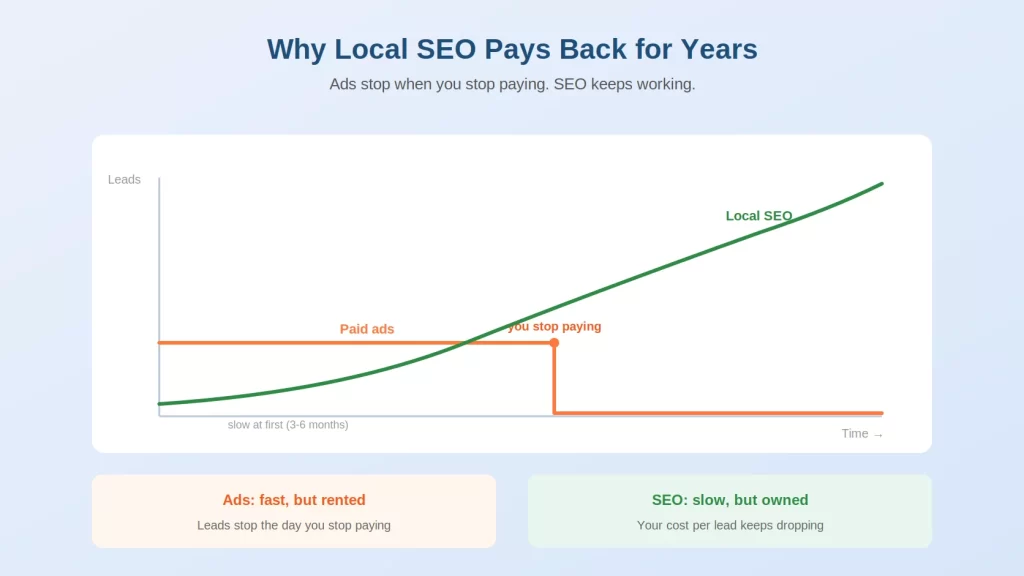
Cost per lead sounds technical. It is not. It just means how much you spend to get one inquiry. With SEO, most of the cost is your time, not ad money. So over time, your cost per lead drops.
That is the quiet power of local SEO for lead generation. Ads stop the moment you stop paying. SEO keeps bringing leads long after the work is done. It grows over time, keeps adding value. It pays you back for years.
SEO Mistakes That Quietly Lose Leads
Some mistakes are loud. You notice them fast. Local SEO mistakes are quiet. They cost you leads for months, and you never see it happen. Here are the ones I see most often in real businesses.
Setting it and forgetting it
This is the big one. A business claims its Google profile, fills it in once, and walks away. A year later, the hours are wrong, there are no new photos, and the reviews sit unanswered. Google notices the silence. So do customers. An active profile beats a neglected one every time.
I’ve seen it happen over and over again while working on advertising for local businesses. The paid ads bring leads in, while the free profile sits ignored, quietly losing easy wins. Keep it alive.
Ignoring reviews
Reviews shape both your ranking and your reputation. Still, many businesses never ask for them, and never reply to them. A profile with a few old reviews looks weak next to a rival with many fresh ones. You do not need to beg. Just ask happy customers, and reply to what comes in.
Messy business details
We said it before, and it is worth saying again. Wrong or mismatched details across the web confuse Google and lose trust. A wrong phone number is worse than no listing at all. Get your details right, everywhere.
Chasing the wrong things
Some owners obsess over one ranking and ignore the whole picture. Or they buy cheap links that do more harm than good. Local SEO rewards steady, honest work. It does not reward shortcuts. Do the easy things right, and you’ll defeat most of your competitors.
Frequently Asked Questions
How long does Local SEO for lead generation take to work?
On your results, what can I say? Well, everything takes time. You can see some results in a couple of weeks. But for substantial results, you need three to six months of consistent work. It won’t give you thousands of leads right away. But these leads will stay with you for a much longer time. And if someone offers you quick results, they are not telling the truth.
Can I do local SEO myself, or do I need to pay someone?
All three aspects can be managed by an owner themselves. All you have to do is take some time to claim your profile, update your information, and request reviews. In addition, you can hire SEO services for some particular tasks, such as improving schema or your website. But the core work is well within your reach.
Do I need a website to get leads with SEO?
A complete Google Business free listing can generate leads on its own. That means you can get started without a website. However, a basic website provides value beyond Google. It will help you rank for other search terms. And act as a landing page for people who find you through other means. Build your profile first, and then launch a simple website if and when you can.
Is local SEO worth it for a very small business?
Yes, and often more so. In a small town, few businesses are eager to invest time and effort in SEO. This will help you tremendously. A small business that knows what it is doing can dominate the local search results. It will help them to win nearby customers for many years to come.
Bringing Your Local SEO Lead Generation Plan Together

Let us rewind. A customer searches. Google calculates distance, relevance, and prominence. The local pack appears with three names: your profile, your website, your listings. And your overall presence determines if your business is displayed among them. The next immediate step is a click, which then turns into a lead.
Your Google Listing is not a one-stop solution, but it is a good place to start. Fix your details across the web. Ask for reviews. Add a few local pages. Each step lifts you a little higher, and each brings more leads.
This is how local SEO lead generation works. It is a steady, honest effort that pays back for years. For a broader look at winning nearby customers, see the wider mix of tactics for small businesses. And to bring every piece together, our complete guide for local business owners ties the whole approach into one plan.
Start today. Pick one step. Your next local customer is already searching.
References
- Search Engine Roundtable (2018) — reporting a Google representative’s statement at the Secrets of Local Search conference that 46% of searches have local intent. Widely cited industry benchmark; not published directly by Google.
- Whitespark, Local Search Ranking Factors (2026) — relative weight of Google Business Profile, on-page, and review signals in local pack rankings (industry estimate, not confirmed by Google).
- Backlinko (2024) — analysis finding roughly 42% of local-search clicks go to the local pack.
- SOCi — report finding local pack businesses receive about 126% more traffic than those ranked 4–10.

1 comment
[…] brand, agency, or business owner, AI-powered SEO tools can transform the way you research keywords, optimize content, analyze competitors, and improve rankings. If you are looking for the best digital […]